


Most people meet your website long before they meet anyone on your team. Plenty never meet your team at all. So if the CMS underneath is awkward to edit, painfully slow or heading for end of life, you pay for it in enquiries that never arrive.
Companies hit this point all the time, and the question that follows is nearly always the same. Should we move to Umbraco? And who do we trust to do it?
We’ll cover the common questions first. Then comes what Umbraco development services include, what moves the price, how Umbraco compares with the alternatives, and how to pick a partner you won’t regret.
Is Umbraco free to use?
The software, yes. Umbraco is open source under the MIT license, so you can download it, install it and run it on your own server without paying a licence fee.
But nobody builds a business website for free. You’ll still pay for developers, hosting, integrations, security updates and support after launch. And Umbraco does sell a few optional extras, like Umbraco Cloud hosting, Umbraco Forms and Umbraco Commerce. Some projects need them.
Ready to Modernize Your Business?
Get practical, no-obligation advice from our certified experts.
What is an Umbraco?
Umbraco is a content management system, or CMS. Your marketing team uses it to write and publish pages without raising a ticket every time something needs changing. It’s built in C# on Microsoft’s .NET, which is why companies that already run on Microsoft tools tend to feel at home with it.
It began in Denmark. These days Umbraco HQ looks after it with help from a big community of developers and agencies worldwide. What sets it apart from a template-based website builder is the starting point: developers get a clean slate, so the site follows your business instead of squeezing your business into a template.
Is Umbraco better than WordPress?
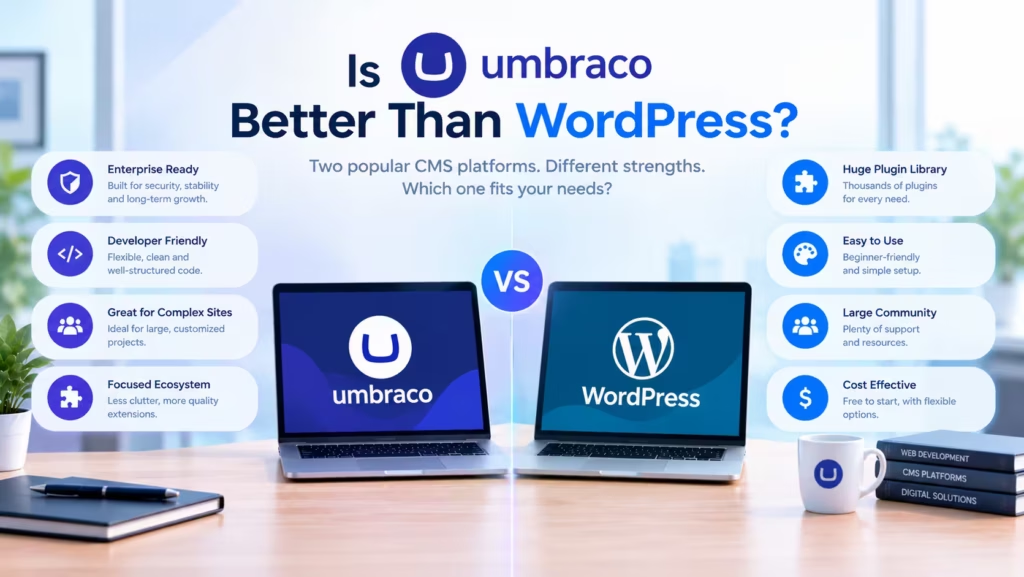
Depends what you’re building.
WordPress is everywhere. Thousands of plugins, easy to start and a good choice for blogs, simple company sites and content-led marketing. I wouldn’t talk anyone out of it for that kind of job.
Umbraco earns its place when things get more specific. Custom content structures. A CRM or ERP that has to talk to the website. Member portals. Stricter security needs. Code that stays readable two years in. It also drops neatly into .NET environments. The price you pay is more developer time at the start, whereas WordPress lets a non-developer piece a site together fast from plugins.
A rough rule: Small budget and simple needs, go with WordPress. Website that behaves more like a business system? Look hard at Umbraco.
What are the top 5 CMS platforms?
It depends on who’s counting. Most market-share lists put WordPress, Shopify, Wix, Squarespace and Joomla near the top. Shopify rules online stores and Wix and Squarespace dominate the do-it-yourself crowd.
Go up a level, to enterprise and developer-led projects, and you’ll see a different shortlist: Drupal, Sitecore, Contentful, Umbraco. Popularity shouldn’t settle it, though. What matters is whether the platform fits your content, your integrations and the people who’ll actually use it.
Here’s what each of the usual top five is actually good at:
- WordPress. Open source, built on PHP and by far the most used CMS on the web. The plugin and theme library is huge, so almost anything can be bolted on. Great for blogs, small business sites and content marketing. The downside is that too many plugins can slow a site down and open security gaps if nobody keeps them updated.
- Shopify. A hosted platform built for selling online. Payments, checkout, inventory and themes come ready-made, so a store can go live fast. It’s less comfortable when you need heavy custom content or unusual business logic.
- Wix. A drag-and-drop website builder with hosting included. Easy for someone with no technical background, and quick for small sites. You trade away flexibility, and moving the site elsewhere later isn’t simple.
- Squarespace. Similar idea to Wix, but known for polished, design-led templates. A good fit for portfolios, creatives and small service businesses. Customization stops at what the templates allow.
- Joomla. Open source like WordPress, but more flexible out of the box for complex structures, user roles and multilingual content. It asks for more technical know-how, and its community and extension library are smaller.
Notice that these five cover three very different jobs: General publishing (WordPress, Joomla), online selling (Shopify) and DIY site building (Wix, Squarespace). They aren’t direct rivals. That’s why a “top 5” list can mislead. A platform that’s perfect for a bakery’s website could be a poor choice for a company that needs member logins, a CRM link and a multi-language site.
This is where Umbraco comes in. It rarely shows up on mass-market lists because it targets a narrower audience: businesses that need a custom, integration-friendly site on .NET and have a development partner to build it.
Is Umbraco a CMS?
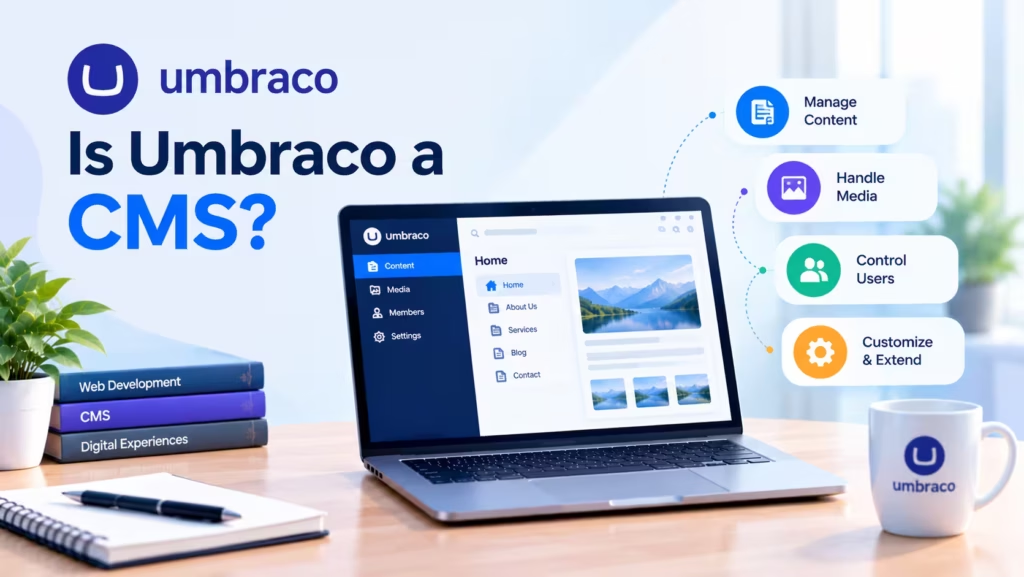
Yes, and a good one. You can also use it more broadly, as a content platform. Run it as a traditional website, or go headless and feed content through an API to mobile apps, single-page apps, in-store screens, whatever needs it. One place to manage content, many places to show it.
Have a Content Platform in Mind?
What are the current versions of Umbraco CMS?
Umbraco puts out a new major version roughly every six months. Every fourth one is a Long-Term Support (LTS) release, timed to match Microsoft’s .NET LTS schedule. The others are Standard-Term Support (STS) releases, and they don’t stay supported for long.
As of late October 2026:
- Umbraco 18 (STS) was released on 25 June 2026.
- Umbraco 17 (LTS) came out on 27 November 2025. This is the one most businesses should target, with security support running into late 2028.
- Umbraco 13 (LTS) hits end of life on 14 December 2026. Still on it? Start planning now.
- Umbraco 19 (STS) is due in December 2026.
- Versions 14, 15 and 16 are out of support already.
Support dates can move, so check Umbraco’s official lifecycle page before you commit to a roadmap. And don’t treat upgrading as a nice extra. An unsupported version simply stops getting security patches.
What is umbraco used for?
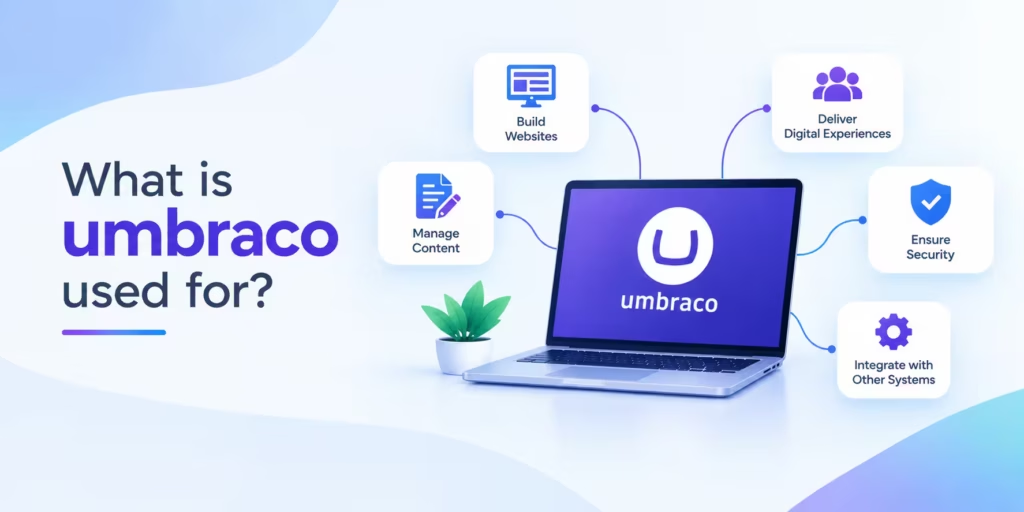
More than you’d think:
- Company and marketing sites where editors control their own layouts
- Multilingual and multi-site setups across regions
- Ecommerce, usually through Umbraco Commerce or a connection to an outside store
- Intranets, portals and members-only areas with different user roles
- Headless delivery of content to apps and other front ends
- Anything that has to exchange data with a CRM, an ERP, marketing automation or analytics tools
Mid-size and large organisations like it, public sector bodies included. The usual reason is simple: editors find it easy, and developers still keep real control.
Where is Umbraco Cloud hosted?

Microsoft Azure. Umbraco Cloud is the company’s own managed hosting. It bundles hosting, deployment tools, separate environments (development, staging, live) and automatic upgrades into a single service, which is handy if you’d rather not run servers yourself.
Nothing forces you into it, though. Umbraco runs perfectly well self-hosted on Azure, AWS or your own hardware. Some companies choose that for compliance or cost reasons. A decent development partner will talk you through both.
Is Umbraco a good CMS?
For the right project, very. Ask teams why they picked it and the same few answers keep coming up:
- Editors find the interface easy, so routine changes don’t wait on a developer.
- Document types and templates are built around your content, not a fixed structure.
- It runs on .NET and has a clear release and support policy, which helps with stability and security.
- Open source plus an active community means no licence lock-in, and plenty of people who know it.
- It scales from a small site to a busy multi-language platform.
Two caveats. It isn’t a drag-and-drop builder. And you’ll want .NET skills on hand, in-house or through a partner, to make the most of it.
What Are Umbraco Development Services?
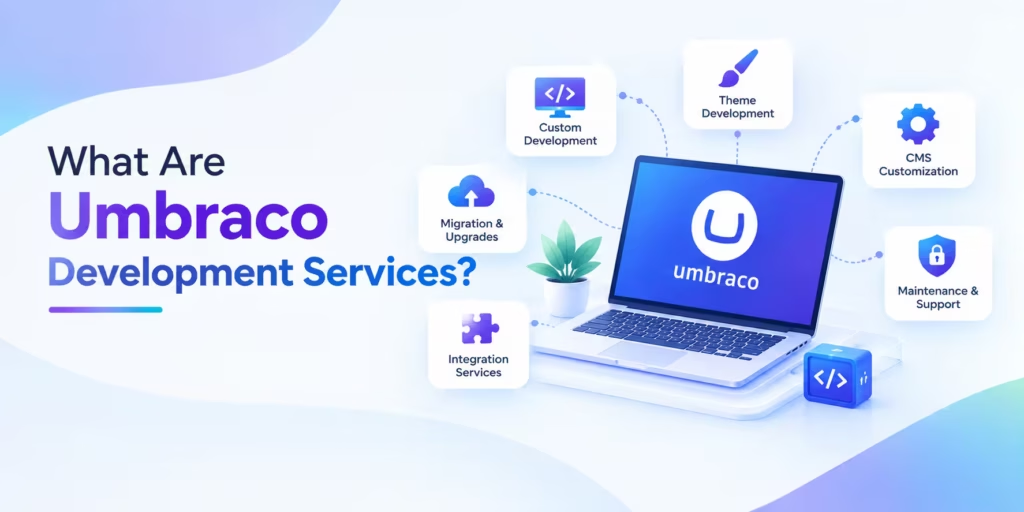
Everything involved in planning, building, launching and then looking after a site or platform on Umbraco. The better providers don’t just write code. They push back on structure, content and priorities, so the finished site actually helps the business.
A typical project moves through discovery, UI/UX design, content modelling, front-end and back-end development, integrations, testing, deployment and support after launch. The aim is a platform that’s secure, can grow with you, and doesn’t make your editors groan.
Types of Umbraco Development Services
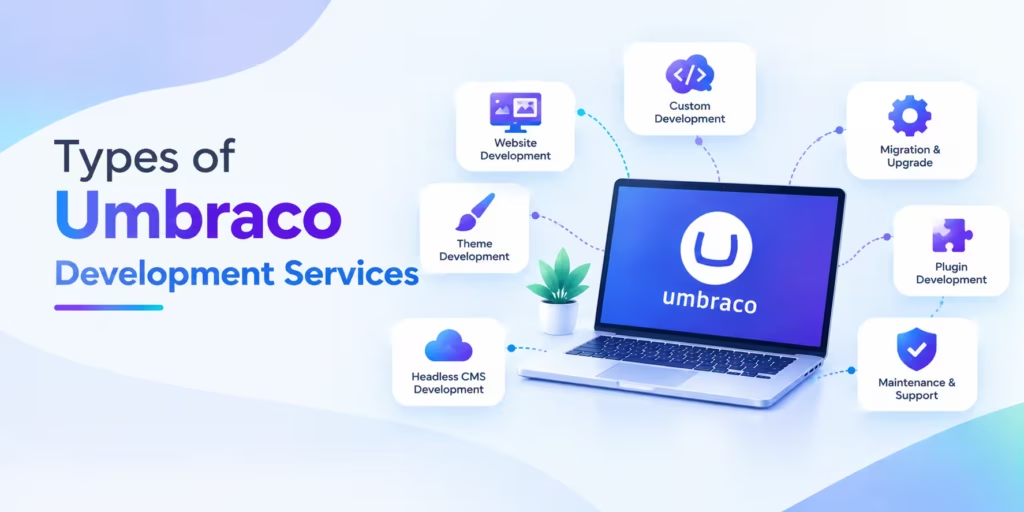
Custom website and platform development. A brand-new Umbraco build, with document types, templates, workflows and design systems made for your brand and content plans.
Customization and feature development. Extra functionality on a site that already exists: custom backoffice sections, member areas, search, forms, multilingual setups, personalisation.
Third-party integrations. Connecting Umbraco to your CRM, ERP, payment gateway, marketing tools, analytics and internal APIs, so no one is copying data between systems by hand.
Migration and upgrade services. Moving content and features from another CMS (WordPress, Sitecore, some old in-house system) into Umbraco, or lifting an older Umbraco site to a current LTS release. Done well, your content structure, URLs and search rankings survive the trip.
Headless and API-first development. Umbraco as the content hub behind web apps, mobile apps and other channels.
Cloud and DevOps support. Hosting on Umbraco Cloud, Azure or AWS, plus CI/CD pipelines, environment management and monitoring.
Support and maintenance. Security patches, performance tuning, bug fixes, version upgrades and small improvements, usually billed hourly or on a retainer.
Looking for the Right Digital Partner?
How Much Do Umbraco Development Services Cost?

There’s no standard price. Umbraco projects vary far too much for that. What you can do is learn what moves the number, so quotes become easier to compare:
- Scope. A brochure site and a multilingual, multi-site platform with custom integrations are different animals.
- Design. Bespoke UI/UX costs more than adapting an existing design system.
- Integrations. Each connected system (CRM, ERP, payments, single sign-on) adds build and testing time.
- Migration. Volume of content, number of templates, and how much SEO value needs protecting.
- Hosting and licences. Umbraco Cloud plans, add-ons and third-party tools keep costing money after launch.
- Team location and model. Rates differ by region, and so does the way you engage people.
Most providers offer a few ways to work together. A fixed-price project suits a well-defined scope. A dedicated team fits long-running or evolving products. An agile engagement helps when requirements will change along the way. An hourly model is usually best for maintenance and support.
One warning. The cheapest quote often isn’t the cheapest result. Ask for a breakdown covering discovery, design, development, testing and support, and budget for ongoing maintenance from day one.
Umbraco CMS vs. Other CMS Platforms
| Platform | Best for | Key strength | Key trade-off |
|---|---|---|---|
| Umbraco | Custom, integration-heavy business sites on .NET | Flexibility, editor experience, clean code | Needs .NET developers |
| WordPress | Blogs, content sites, quick launches | Huge plugin ecosystem, low entry cost | Plugin sprawl can hurt security and performance |
| Drupal | Complex, content-heavy sites with granular permissions | Powerful and highly configurable | Steeper learning curve |
| Sitecore | Large enterprises needing advanced personalisation | Deep marketing and experience features | High licence and implementation cost |
| Shopify | Online stores | Fast ecommerce setup, built-in payments | Less suited to complex content or custom logic |
| Contentful | Headless, multi-channel content | API-first architecture | Requires a separate front-end build |
How to Choose an Umbraco Development Partner

The partner often matters more than the platform. What to check:
- Real Umbraco and .NET experience. Ask for live sites and case studies. Ask which versions they’ve worked on, recent LTS releases included.
- A clear delivery process. Proper discovery, agile delivery, regular updates, and a named project manager you can actually reach.
- Design and UX skills. Good UX has to be part of the build from the start. Added at the end, it rarely works.
- Security and quality credentials. ISO 27001 and ISO 9001, plus code reviews and testing habits, suggest a mature way of working.
- A migration and upgrade track record. Ask exactly how they protect SEO, URLs and content when moving between platforms or versions.
- Flexible engagement models. Fixed-price, dedicated team, agile and hourly options, so the setup fits your project and not theirs.
- Support after launch. The site will need patches, upgrades and tweaks long after go-live. Find out what support looks like and how quickly they answer.
- Cloud and DevOps know-how. Experience with Azure, AWS and deployment automation means smoother releases and less downtime.
How Cloud Converge helps
Cloud Converge is an ISO 27001 and ISO 9001:2015 certified digital transformation partner. Umbraco implementation sits alongside our .NET Core, cloud engineering and DevOps work. Every project gets UI/UX designers, delivery is agile and transparent, and our developers go through third-party testing and scoring. You can engage us on a fixed-price, dedicated team, agile or hourly basis, and we stay on after launch for maintenance and support.
If your team already lives in the Microsoft world, wants a say in the architecture and needs a CMS that editors don’t dread opening, Umbraco sits in a handy middle spot between lightweight builders and heavyweight enterprise suites.
Ready to Modernize Your Business? Start with a Free Consultation.
Whether you are planning a new Umbraco build, migrating from another CMS or upgrading before Umbraco 13 reaches end of life, our certified experts will help you plan the right path. Book your free consultation today. There is no obligation, just practical, scalable advice.
Start with a Free Consultation
ISO 27001 & ISO 9001:2015 certified | AWS & Microsoft partner | 70+ happy customers in 12+ countries
Phone: +91 7827902509 | Email: info@cloudconverge.io | Web: https://www.cloudconverge.io/contact/