

Two companies can pick the same open-source ERP and end up with very different results, because the platform shapes how easily the business can change later. Odoo vs ERPNext is the comparison where that shows most clearly. Both products are open source at the core, yet they differ in licensing, in how much you can change without extra licences and in how often they force an upgrade. This guide sets the two side by side as they stand in November 2026, with Odoo 20 and ERPNext v16 both current, so a finance or operations lead in Europe or Asia can shortlist with confidence.
Odoo vs ERPNext
Odoo is a broad, polished business suite where most companies end up on a paid Enterprise plan charged per user each month. ERPNext is a fully open-source ERP built on the Frappe framework, with all modules part of the open-source core. Choose Odoo for breadth and a refined interface; choose ERPNext when headcount is growing or deep customisation matters. Cloud Converge is an ERPNext partner and helps teams test that fit before committing.
- What they are: two open-source ERP platforms written in Python. Odoo comes from Odoo S.A. in Belgium; ERPNext comes from Frappe Technologies in India.
- Licensing: Odoo Community is LGPLv3, while Odoo Enterprise adds proprietary apps under a paid subscription. ERPNext and its add-on apps such as India Compliance use GPLv3.
- Commercial model: Odoo Enterprise is a per-user subscription. ERPNext has no licence fee; you pay for hosting and services.
- Current versions: Odoo 20 (launched September 2026) and ERPNext v16 (released 12 January 2026).
- Best fit: Odoo suits teams wanting many ready-made apps under one vendor. ERPNext suits manufacturers, distributors and service firms that want full control of the code as staff numbers rise.
How to decide in five steps
- List the processes the ERP must run on day one, such as accounting, stock, manufacturing, payroll and ecommerce.
- Count named users now and in three years, since Odoo licensing scales with that figure.
- Check the statutory localisation for every country where you file taxes.
- Decide who will host, upgrade and patch the system.
- Run a two-week pilot with real data on your shortlisted platform before signing anything long term.
Valuable Points to Know Before Choosing Between Odoo and ERPNext
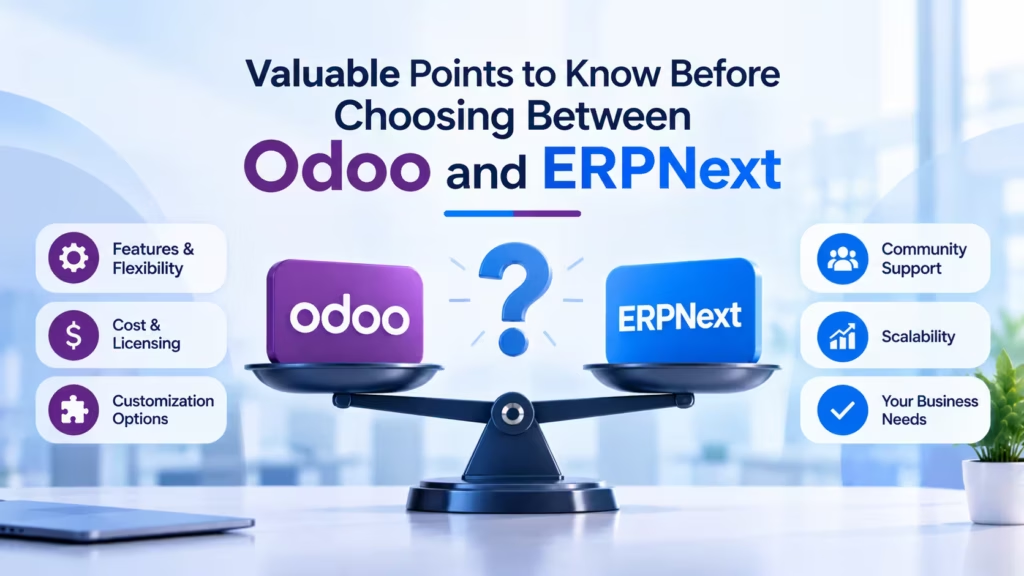
- Plan for the team you will have. Odoo Enterprise is licensed per user, so growth adds seats to the subscription. ERPNext does not tie its licence to logins, which matters most for firms adding warehouse, shop-floor or field staff.
- Odoo Community is not Enterprise for free. The open edition omits several apps that finance teams lean on, including much of full accounting reporting, Studio and the official mobile experience. Many firms that start on Community move to a paid plan within a year.
- Custom code needs Odoo’s Custom plan. Standard runs only on Odoo Online with no custom modules. Studio, the external API, multi-company setups, Odoo.sh and on-premise hosting all sit on the higher tier.
- Upgrades are a recurring project. Odoo ships a major release each year and supports only the three newest. ERPNext moves more slowly, with v15 planned for support until the end of 2027 and v16 until the end of 2029.
- Localisation decides more deals than features do. An Indian company needing GST e-invoicing and e-way bills on ERPNext installs the India Compliance app, and its government API features need a paid India Compliance account. Check the equivalent for each country you trade in.
- Keep customisations outside the core. Teams that edit core files on either platform pay for it at every upgrade. Build changes as separate apps or modules so they can be tested and moved forward.
From Licensed ERP to Open Source: What Changed
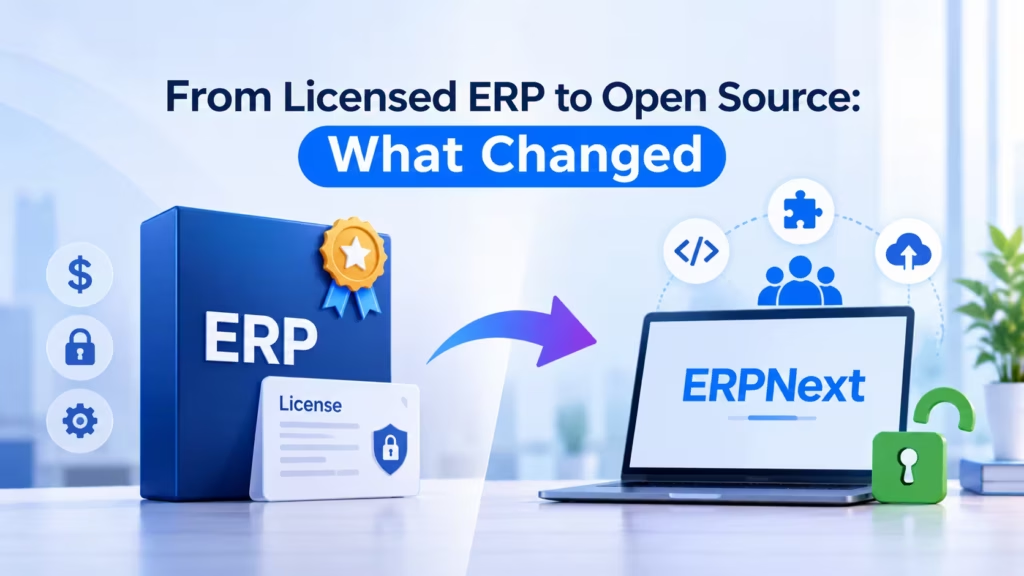
Fifteen years ago, a mid-sized firm bought an ERP the way it bought a building. It paid a large upfront licence, installed the software on its own servers and then paid around a fifth of that licence every year for maintenance. Changes went through the vendor or a certified reseller, and upgrades were rare because each one was expensive.
Open-source ERP flipped several of those assumptions. Both platforms in this comparison still reward careful planning, but the cost structure, the speed of change and who owns the code look very different now.
| Criteria | Traditional licensed ERP | Open-source ERP (Odoo, ERPNext) |
| Upfront cost | Large perpetual licence | No licence for the core, or a monthly subscription |
| Hosting | Own servers in your office or data centre | Vendor cloud, managed partner or your own servers |
| Customisation | Vendor or reseller only | Any developer who knows Python and the framework |
| Release pace | Major version every few years | Yearly (Odoo) or roughly every two years (ERPNext) |
| Lock-in | High, data and code owned by the vendor | Lower, code is readable and data can be exported |
| Best fit | Large firms with stable, heavily regulated processes | SMBs and growing mid-market firms that need flexibility |
The older model is not wrong. Banks and large manufacturers still run it because certification and vendor accountability matter to their auditors. For most growing companies, though, open-source ERP now gives similar coverage at a fraction of the cost.
Odoo vs ERPNext Side by Side
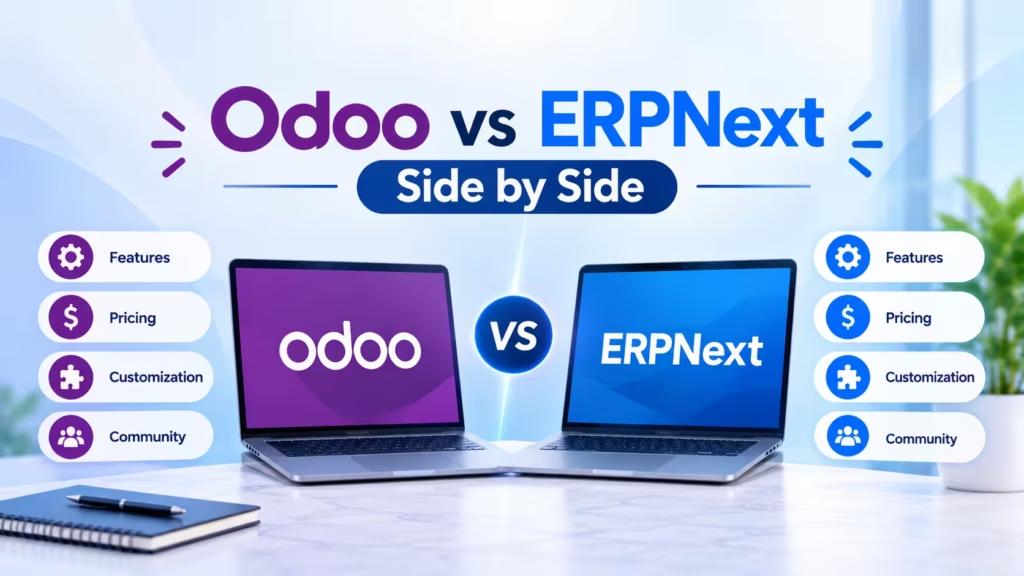
The biggest differences sit in licensing, pricing logic and how far you can bend each product without paying extra.
| Criteria | Odoo | ERPNext |
| Licence | Community under LGPLv3; Enterprise proprietary | GPLv3 for ERPNext; every module open |
| How you pay | Per user per month (One App Free covers a single app) | Hosting by compute and storage, plus implementation |
| App breadth | Very wide, with a large third-party marketplace | Core ERP plus Frappe apps such as HR, CRM, Helpdesk and Insights |
| No-code changes | Odoo Studio, Custom plan only | Custom Fields, Customize Form and Server Scripts built in |
| Developer model | Python modules on the Odoo ORM | Frappe framework apps built around DocTypes |
| Release cycle | Annual; three newest versions supported | Roughly two years between majors; v16 supported to end of 2029 (planned) |
| Official cloud | Odoo Online and Odoo.sh | Frappe Cloud |
Our recommendation: if your team values a refined interface and wants many apps ready on day one and a per-user subscription suits you, Odoo is a strong choice. If you expect headcount to grow, need deep process changes or want every module without an edition gap, ERPNext is usually the better long-term fit.
How to Run a Fair Pilot of Odoo and ERPNext
Demos show each product at its best. A pilot with your own data shows how it handles your awkward cases, which is where most ERP projects succeed or stall. Two weeks is usually enough if the scope is tight and the right people take part.
Start by picking three to five end-to-end processes that matter most, such as order to cash, procure to pay and plan to produce. Load a realistic slice of master data: a few hundred items, real customers and suppliers, and your actual chart of accounts. Then ask the people who will use the system daily to run those processes themselves with a consultant beside them rather than at the keyboard.
| What to test | What a good result looks like | Common warning sign |
| Core processes | Users finish each flow without workarounds | Spreadsheets reappear between steps |
| Localisation | Tax invoices and returns match your statutory format | Reports need manual correction before filing |
| Your exceptions | Partial deliveries, returns and back-orders behave as expected | Edge cases need custom code from day one |
| Reporting | Managers get the views they use today | Every key report needs to be built from scratch |
| Integrations | Ecommerce, bank feeds and shipping connect through standard connectors | Each link needs a bespoke middleware build |
| Role permissions | Staff see only what their job requires | Access can only be split by module, not by field |
Score each row on a simple scale and note who scored it. If a platform needs heavy custom work just to pass the pilot, that work will grow, not shrink, after go-live.
A frequent mistake is piloting Odoo Community against ERPNext as if the two were equivalent. Odoo Community leaves out several apps that Enterprise includes so test the edition you would actually run in production.
Customisation and Upgrades: Where Long-Term Effort Hides
Odoo releases a new major version every autumn. Odoo 20 launched at Odoo Experience in Brussels on 24 September 2026, with standard support planned until September 2029. Fixes stop once a release falls outside the latest three, so a company on Odoo 17 lost support when version 20 arrived. Odoo Online customers are moved to new versions on Odoo’s schedule, while those on Odoo.sh or their own servers choose when to move. Community users have no official upgrade service and rely on community tools such as OpenUpgrade or a partner.
ERPNext takes a slower path. Version 16 arrived on 12 January 2026, the first major release in about two years, together with Frappe Framework v16 and Frappe HR v16. It needs a newer server stack, including Python 3.14, Node.js 24 and MariaDB 11.8, so self-hosted teams should plan infrastructure work as well as data migration. Version 14 reached end of life on 31 January 2026.
On both platforms, the size of an upgrade depends far more on your custom code than on the vendor. A good rule: every customisation should live in its own app or module, have automated tests, and be documented with the business reason it exists. When a change no longer has a reason, retire it before the next upgrade rather than porting it forward.
Regional Fit for Europe and Asia
India. Frappe moved the country’s tax features out of ERPNext core into a separate app, India Compliance, maintained by Resilient Tech under GPLv3. It covers GST, e-invoicing, e-way bills, TDS and TCS, and it validates transactions against local rules. Odoo also offers Indian localisation, so confirm which e-invoicing and GST return features your chosen edition includes.
Europe. GDPR applies to any ERP holding employee or customer records, so confirm where your data is stored and sign a data processing agreement with whoever hosts it. Frappe Cloud lets you pick the hosting region when you create a site. Odoo has a long list of European localisation packages; check that yours covers your VAT reporting and any e-invoicing format your government requires.
Southeast Asia and the Gulf. Both platforms support multiple currencies, languages and right-to-left layouts. Local payroll rules are the usual gap, so verify payroll coverage early or budget for a custom module.
Working across time zones. India Standard Time (UTC+5:30) overlaps with most of the European working day and fully with Asian business hours, which helps when an offshore team handles configuration and support.
When to Choose Odoo and When to Choose ERPNext
Odoo is the better pick when:
- you want ecommerce, website, marketing and ERP from one vendor with a consistent interface;
- your user count is small and stable;
- you prefer the vendor to handle hosting and yearly upgrades on Odoo Online.
ERPNext makes more sense when:
- your team is expanding quickly, especially in operational roles;
- manufacturing, subcontracting, batch and serial tracking or multi-company accounting sit at the heart of your business;
- you want full access to every module and the right to change any of it;
- Indian GST compliance is a requirement and you want it in the same system.
Neither product suits every case. If a firm needs heavily regulated industry certification or global consolidation across dozens of entities, a larger tier-one ERP may still be the honest answer.
How Cloud Converge Helps
Cloud Converge is an ERPNext partner and you can hire ERPNext developers or consultants from our team for implementation, customisation, data migration and upgrades. Delivery follows ISO 27001 and ISO 9001:2015 certified processes under a named Project Manager supported by our Project Management Office. You can engage us at a fixed price, as a dedicated team, through agile delivery or on an hourly basis for ongoing support.
Our free consultation starts with your processes and growth plans, not with a product pitch, so you leave with a clear view of whether ERPNext fits.
Find Out If ERPNext Fits Your Business
Choosing an ERP is a five-to-ten-year decision. Before you sign a per-user subscription or start an implementation, test the numbers and the processes with someone who has done it. Book your free consultation and get a practical assessment of ERPNext for your company, with no obligation.
Frequently Asked Questions
Is ERPNext really free?
Yes. ERPNext is released under GPLv3 with every module included and no licence fee. You still pay for hosting, either on Frappe Cloud, with a managed partner or on your own server, plus any implementation and support work.
Which is easier to customise?
ERPNext lets administrators add fields, forms and server scripts from the browser, and every module is open to change. Odoo offers similar no-code changes through Studio on its Custom plan, while deeper work on either platform means writing Python modules or apps.
Can I move from Odoo to ERPNext?
Yes. Master data such as customers, suppliers, items and the chart of accounts can be exported from Odoo and imported into ERPNext. Open transactions and stock balances need a planned cut-over date, and historical data is often kept read-only in the old system.
Which is better for manufacturing?
Both cover bills of materials, work orders and production planning. ERPNext includes manufacturing, subcontracting and serial and batch tracking in its free core, and v16 added inward subcontracting and better production planning. Odoo’s manufacturing is strong, with advanced features such as quality and PLM on Enterprise.
Does Cloud Converge offer a free consultation?
Yes. Book a free consultation to discuss your processes, users and target countries with no obligation. We are ISO 27001 and ISO 9001:2015 certified and work with over 70 customers in more than 12 countries.