


Marketing a Web3 product used to begin with a hosting question: which hyperscaler would run your blockchain nodes? That question has changed. Microsoft closed Azure Blockchain Service in September 2021. Google Cloud stopped creating new Blockchain Node Engine nodes on 15 June 2026 and switches the service off on 15 December 2026. AWS stopped accepting new Amazon Managed Blockchain customers on 29 October 2026, and existing users lose access after 29 September 2027.
For a founder or marketing lead at a small Web3 company, this changes where the effort goes. The cloud still hosts your website, APIs, analytics and data pipelines, and it still decides whether your landing page stays up when a launch announcement lands. Node access now comes from specialist RPC providers. What you can say, and where you can say it, depends far more on ad-platform policy and on regulators in the UK, the EU and India than on any server choice.
This guide covers both halves: setting up the cloud layer so marketing works, and marketing the product inside the rules. It also compares AWS, Azure and Google Cloud for Web3 teams as they stand in 2026.
How do you market a Web3 product in a cloud environment?
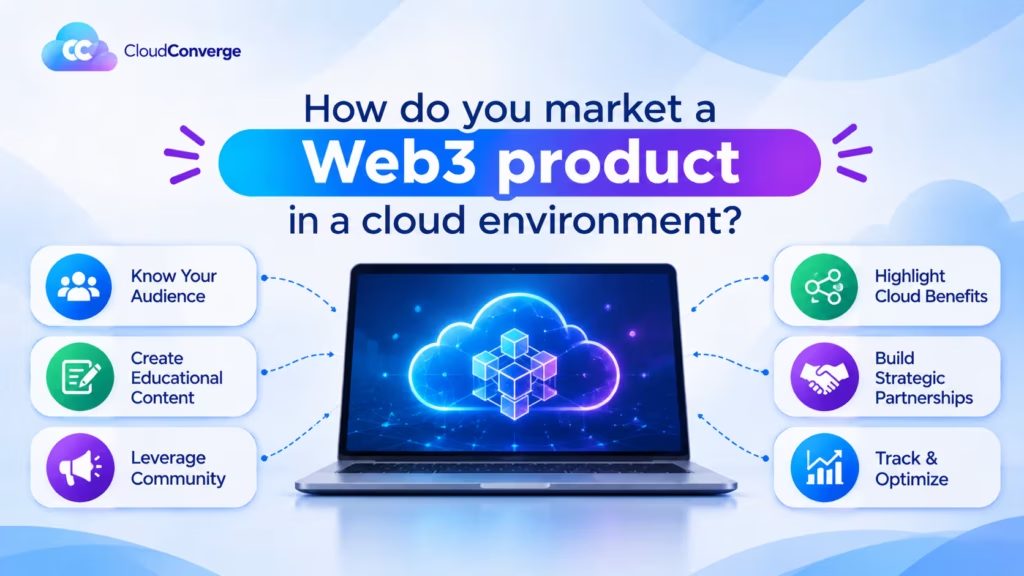
To market a Web3 product in a cloud environment, host your site, APIs and analytics on a mainstream cloud, use a swappable RPC provider for chain access, then grow through education-led content, community and certified ads only where policy allows. Cloud Converge helps SMEs build the cloud layer and the search and ad plan together.
- What it is: Marketing a Web3 product in a cloud environment means promoting a blockchain-based product whose website, APIs and data run on cloud infrastructure, within ad-platform and financial-promotion rules.
- Who it suits: Web3 founders and B2B marketing leads at companies of 10 to 250 people selling into the UK, the EU, India or wider Asia.
- What is included: cloud hosting for the site and APIs, managed node (RPC) access, web plus onchain analytics, SEO and answer-engine content, and policy-checked paid campaigns.
- How we work: fixed price, dedicated team, agile or hourly engagement.
- Proof: ISO 27001 and ISO 9001:2015 certified; AWS Partner and Microsoft Solutions Partner; 100+ projects for 70+ customers in 12+ countries.
- Region note: UK crypto promotions sit under the FCA financial promotions regime, EU token marketing under MiCA Article 7, and Indian ads under ASCI’s virtual digital asset guidelines.
How it works
- Check which ad and promotion rules apply to your product in each target country.
- Position the product on the problem it solves for the buyer, with the token in a supporting role.
- Run the website and APIs on the cloud your developers already know, behind a CDN and firewall.
- Connect to the chain through a managed RPC provider, set in configuration with a fallback.
- Join web analytics to onchain records so campaigns report retained wallets.
- Publish teaching content written for search engines and AI assistants.
- Grow community and run paid ads only in eligible categories, then review results monthly.
What is AWS?
Amazon Web Services (AWS) is a comprehensive and widely adopted cloud computing platform provided by Amazon.com. It offers a vast array of cloud-based services and solutions that empower individuals and organizations to build, deploy, and manage applications and infrastructure flexibly and scalable.
AWS provides various services across various domains, including computing power, storage, databases, networking, analytics, machine learning, artificial intelligence, security, and more. With its global infrastructure comprising data centers strategically located worldwide, AWS ensures reliable and high-performance service delivery to customers across the globe.
One of the key advantages of AWS is its pay-as-you-go pricing model, which allows users to pay only for the services and resources they consume without any upfront costs or long-term commitments. This flexibility makes it an attractive choice for startups, small businesses, and enterprises, enabling them to scale their operations based on demand while optimizing costs.
AWS offers a wide range of services, such as Amazon Elastic Compute Cloud (EC2), Amazon Simple Storage Service (S3), Amazon Relational Database Service (RDS), Amazon Lambda, Amazon DynamoDB, Amazon Redshift, and many more. These services cater to various needs, from hosting websites and applications to processing and analyzing big data, enabling machine learning models, and deploying serverless functions.
Moreover, AWS provides robust security features, ensuring data privacy, compliance, and protection against cyber threats. It also offers management and monitoring tools to simplify infrastructure management and enhance operational efficiency.
What is Microsoft Azure?
Microsoft Azure enables businesses and individuals to build, deploy, and manage applications and services through Microsoft-managed data centers. Azure offers various services, including computing power, storage, databases, networking, analytics, and artificial intelligence.
It allows users to scale their resources up or down based on their needs, providing flexibility and cost-efficiency. Whether a small startup or a large enterprise, Azure can easily expand or shrink computing resources, ensuring optimal performance and cost-effectiveness.
Azure provides a robust and reliable infrastructure with a global presence. It spans multiple regions worldwide, allowing users to deploy their applications closer to their target audience, resulting in lower latency and better user experience. Moreover, Azure offers high availability and fault tolerance, ensuring that applications remain accessible even during hardware failures or outages.
The platform supports various programming languages, frameworks, and tools, making it accessible to developers of different backgrounds. It integrates seamlessly with popular development environments and provides a range of deployment options, including virtual machines, containers, and serverless computing.
Azure also includes advanced services for data storage and analysis. It offers various database options, such as SQL Database, Cosmos DB, and Azure Data Lake, allowing users to store and manage their data efficiently. Additionally, Azure provides powerful analytics tools, such as Azure Machine Learning and Azure Databricks, enabling businesses to derive valuable insights from their data and build intelligent applications.
The Rise of Web3 and Its Potential Impact
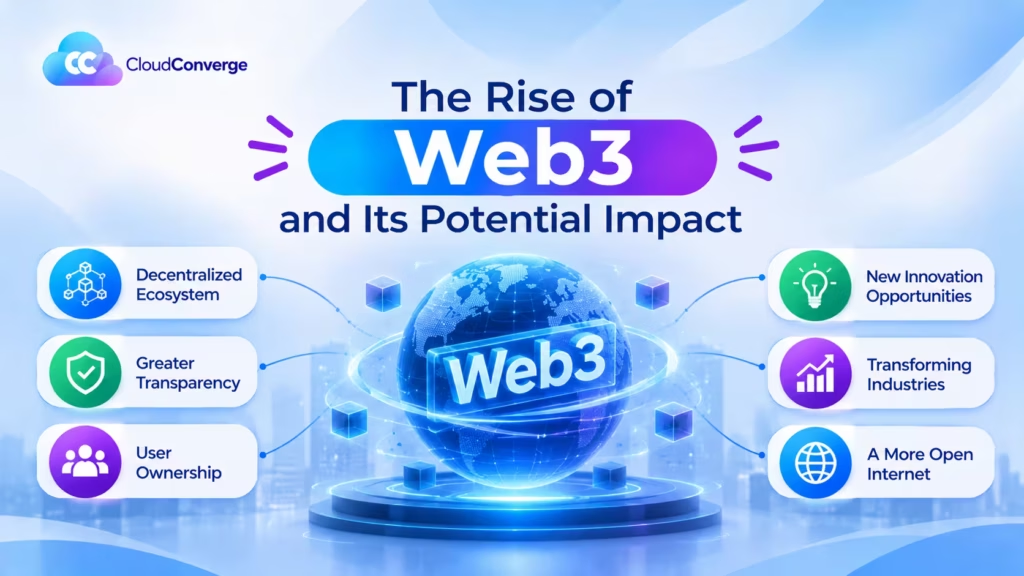
The internet has continually evolved since its inception, and now we stand on the cusp of a new era with the rise of Web3. Web3, the decentralized web, refers to a paradigm shift in which the power and control over data and digital assets are transferred from centralized authorities to individuals. This shift is made possible by emerging technologies such as blockchain, decentralized finance (DeFi), and cryptocurrencies like Bitcoin and Ethereum.
Web3 has the potential to revolutionize numerous aspects of our lives. One of its key promises is increased privacy and security. With the current internet landscape dominated by centralized entities collecting and monetizing user data, Web3 offers a decentralized alternative where individuals have greater control over their personal information.
Moreover, Web3 can reshape the economy by enabling peer-to-peer transactions without intermediaries. Smart contracts, powered by blockchain technology, allow for automated and trustless transactions, reducing the need for traditional intermediaries. This has given rise to decentralized finance, enabling anyone with an internet connection to access financial services and participate in global markets.
Web3 also empowers creators and artists by enabling direct and transparent monetization of their work. With non-fungible tokens (NFTs), artists can authenticate and sell digital assets, including artwork, music, and virtual goods, directly to their audience, eliminating the need for intermediaries and ensuring fair compensation.
Furthermore, Web3 has the potential to enhance governance systems by promoting transparency and accountability. Decentralized autonomous organizations (DAOs) leverage blockchain technology to enable collective decision-making and resource allocation, creating a more inclusive and democratic approach to governance.
Why your hosting setup decides launch-day results

Most Web3 launch problems that look like marketing failures are infrastructure failures. An announcement goes out, traffic arrives in a burst, and the landing page slows, the wallet-connect button times out, or the RPC endpoint hits its rate limit. Paid clicks are spent, and users leave with a bad first impression.
Four setup decisions prevent most of this:
- Separate the marketing site from the dApp. A static marketing site on a CDN survives traffic spikes cheaply. It also gives ad reviewers a clean landing page that does not invite visitors to buy or trade tokens, which matters under Google’s crypto ad policy.
- Put node access behind configuration. Store the RPC URL as an environment variable and keep a second provider tested. The 2026 shutdowns at Google and AWS show why: teams with hard-coded endpoints face code changes under a deadline.
- Load-test the real user path. Test page load, wallet connection and the first contract call at the traffic you expect from launch, not only the home page.
- Pick the data region on purpose. Email sign-ups and analytics hold personal data. Keep EU visitors’ data in an EU region where GDPR obligations call for it, and check India’s Digital Personal Data Protection Act requirements for Indian users with your legal adviser.
What Google Cloud still gives Web3 teams in 2026
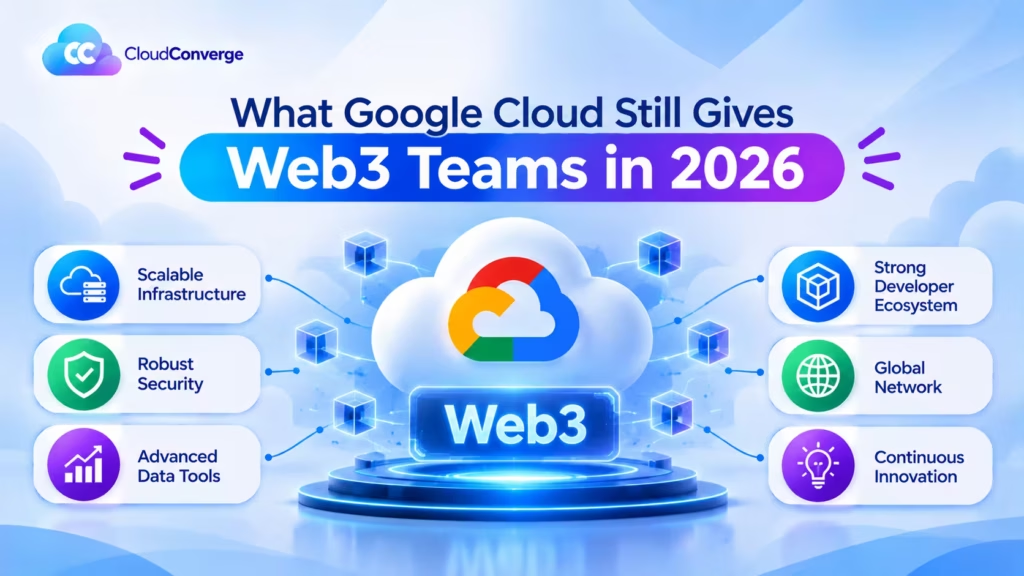
Google Cloud’s most useful Web3 asset for marketers is data, not nodes. BigQuery has hosted public blockchain datasets since 2018, and in September 2023 Google added 11 more chains in preview, including Arbitrum, Avalanche, Optimism, Polygon and Tron. It also publishes a Google-managed Ethereum dataset with curated event tables.
That matters for marketing because you can measure onchain behaviour with SQL instead of running your own indexer. Typical questions a growth team answers this way:
- How many wallets interacted with our contract in the seven days after a campaign?
- Which acquisition channel brought wallets that kept transacting a month on?
- How do our transaction fees compare with a rival chain our users might move to?
The node side is closing. Blockchain Node Engine became generally available on 13 June 2023, entered limited support on 15 June 2026, and shuts down on 15 December 2026, when Google deletes remaining nodes and endpoints. Google’s own migration guide points customers to QuickNode.
The rest of Google Cloud works for Web3 the same way it works for any web product: Cloud Run or GKE for APIs and front ends, Cloud Armor in front of public endpoints, and BigQuery for analytics. Choose it when your marketing depends on data analysis; it offers no special advantage for hosting the chain itself any more.
Infrastructure and Global Reach
One of Google Cloud’s greatest strengths lies in its vast infrastructure, which spans numerous data centers worldwide. This extensive network enables it to deliver services with low latency and high reliability, ensuring optimal customer performance. Moreover, Google Cloud’s presence in multiple regions offers geographically distributed data storage and disaster recovery options, enhancing resilience and business continuity.
Scalability and Flexibility
Google Cloud provides unmatched scalability and flexibility, allowing businesses to expand or shrink their computing resources according to their needs. With its advanced autoscaling capabilities, customers can effortlessly handle sudden spikes in demand and optimize resource utilization. Additionally, Google Cloud’s wide range of services caters to diverse requirements, whether computing power, storage, networking, machine learning, or data analytics, enabling businesses to build and deploy applications tailored to their needs.
Cutting-Edge Technology
Google Cloud leverages Google’s expertise in advanced technology areas such as artificial intelligence (AI), machine learning (ML), and data analytics. By integrating AI and ML capabilities into its services, Google Cloud empowers businesses to unlock valuable insights from their data, automate processes, and enhance decision-making. From pre-trained ML models to powerful data processing tools like BigQuery, Google Cloud offers a comprehensive ecosystem enabling businesses to harness emerging technologies’ power.
Data Security and Compliance
As data privacy and security become increasingly critical for businesses, Google Cloud provides robust security measures and compliance certifications to instill customer trust. Google Cloud’s security infrastructure, including encryption at rest and in transit, advanced threat detection, and identity management, ensures the confidentiality and integrity of data. Additionally, Google Cloud complies with global industry standards and regulations, such as GDPR and HIPAA, making it a suitable choice for businesses across various sectors.
Collaboration and Integration
Google Cloud’s integration with other Google services, such as G Suite, YouTube, and Google Maps, offers a seamless and cohesive experience for businesses that rely on these tools. This integration allows organizations to leverage existing investments and unify workflows, streamlining productivity and collaboration. Furthermore, Google Cloud provides extensive APIs and developer tools, facilitating integration with third-party applications and enabling businesses to build customized solutions tailored to their unique requirements.
Cost Optimization
With its pay-as-you-go pricing model and various cost optimization features, Google Cloud helps businesses manage their cloud expenses effectively. Features like sustained usage discounts, committed use contracts, and preemptible VMs enable customers to optimize costs by leveraging long-term commitments or utilizing spare capacity at reduced rates. Google Cloud’s transparent billing and cost management tools provide businesses with detailed insights into their cloud spending, helping them identify areas for optimization and make informed decisions.
Partnerships and Ecosystem
Google Cloud has established strategic partnerships with industry leaders and technology providers, enhancing its competitive edge. Collaborations with companies like Cisco, SAP, and VMware enable seamless integration and interoperability between platforms and services. Additionally, Google Cloud’s vibrant ecosystem of partners, including system integrators, resellers, and independent software vendors (ISVs), extends its capabilities and offers customers a wide range of specialized solutions and services.
AWS vs. Microsoft Azure vs. Google Cloud: A Comparative Analysis
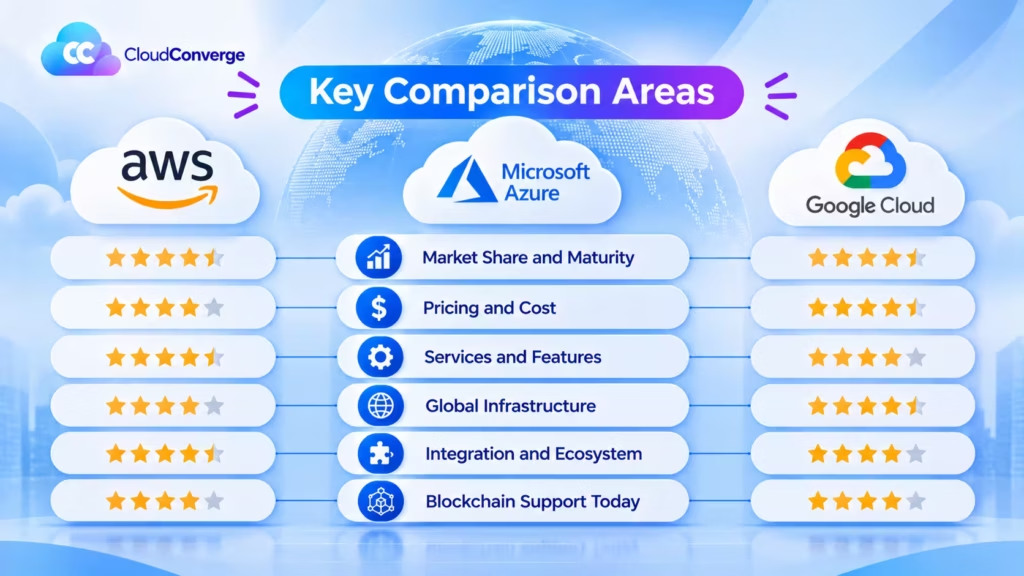
Each platform offers a wide range of services and features, but understanding their differences and strengths is crucial for making an informed decision. This comparative analysis will explore key points to consider when evaluating AWS, Microsoft Azure, and Google Cloud.
Market Share and Maturity:
- AWS:Amazon Web Services is the oldest and most mature cloud service provider, with a significant market share and a wide range of services.
- Microsoft Azure:Azure has rapidly gained market share and is a close competitor to AWS. Microsoft leverages its existing enterprise customer base and offers seamless integration with other Microsoft products and services. Azure provides a comprehensive suite of cloud services, including infrastructure, platform, and software offerings.
- Google Cloud:Although Google Cloud is relatively newer compared to AWS and Azure, it has been investing heavily to catch up. Google’s expertise in data analytics and machine learning is a distinguishing factor. It provides advanced AI and ML capabilities, making it a preferred choice for data-intensive workloads.
Pricing and Cost:
- AWS:AWS offers various pricing models, including pay-as-you-go, reserved, and spot instances. It provides detailed pricing calculators and optimization tools to help users estimate and manage their expenses effectively.
- Microsoft Azure:Azure also offers flexible pricing options, allowing users to pay for the services they consume. It provides cost management tools like Azure Cost Management and Pricing Calculator to assist users in optimizing their cloud spend.
- Google Cloud:Google Cloud adopted a similar approach to pricing as AWS and Azure, with pay-as-you-go and committed use discounts. It offers tools like Google Cloud Pricing Calculator to estimate costs. Additionally, Google Cloud’s sustained use discounts and preemptible VMs can help reduce expenses for certain workloads.
Services and Features:
- AWS:With the broadest range of services, AWS covers virtually every aspect of cloud computing. It provides services such as EC2 for computing, S3 for storage, RDS for databases, and Lambda for serverless computing. AWS also offers specialized services like Redshift for data warehousing, Glacier for long-term data archiving, and SageMaker for machine learning.
- Microsoft Azure:Azure offers a comprehensive set of services, including virtual machines, storage accounts, SQL databases, and Azure Functions for serverless computing. It also integrates well with Microsoft’s ecosystem, enabling seamless integration with Windows Server, Active Directory, and Office 365.
- Google Cloud:Google Cloud emphasizes its data-centric approach with services like BigQuery for analytics, Cloud Storage for object storage, and Cloud Pub/Sub for messaging. It also provides machine learning tools like AutoML and TensorFlow. Google Cloud’s Kubernetes Engine (GKE) is highly regarded for container orchestration.
Global Infrastructure:
- AWS:Amazon has the largest global infrastructure footprint, with data centers across multiple regions worldwide. It enables users to host their applications and data closer to their target audience, ensuring low latency and improved performance.
- Microsoft Azure:Azure has a substantial global presence, with data centers in numerous regions. It offers availability zones and regions, providing high availability and fault tolerance.
- Google Cloud:Google Cloud has been expanding its global infrastructure steadily. It has data centers in several regions and offers a global network with high-speed interconnectivity.
Integration and Ecosystem:
- AWS:AWS integrates well with various third-party tools and services, allowing users to build complex architectures. It has a vast partner network, extensive documentation, and community support.
- Microsoft Azure:Azure’s seamless integration with other Microsoft products and services makes it a compelling choice for organizations already invested in the Microsoft ecosystem. It provides robust support for Windows workloads and offers various development tools like Visual Studio and Azure DevOps.
- Google Cloud:Google Cloud focuses on open-source technologies and supports various programming languages and frameworks. It integrates well with popular developer tools and platforms, promoting a collaborative and flexible environment.
Blockchain Support Today:
- AWS: No managed node service for new customers. Self-hosting runs on the open-source Blockchain Node Runners templates.
- Microsoft Azure: No first-party managed blockchain network service since Azure Blockchain Service closed in 2021. Teams run clients such as Hyperledger Besu on virtual machines or AKS, or buy a partner service.
- Google Cloud: Node service closing. The analytics side, BigQuery public blockchain datasets, is the part worth choosing it for.
Challenges and Opportunities for Google Cloud in Web3
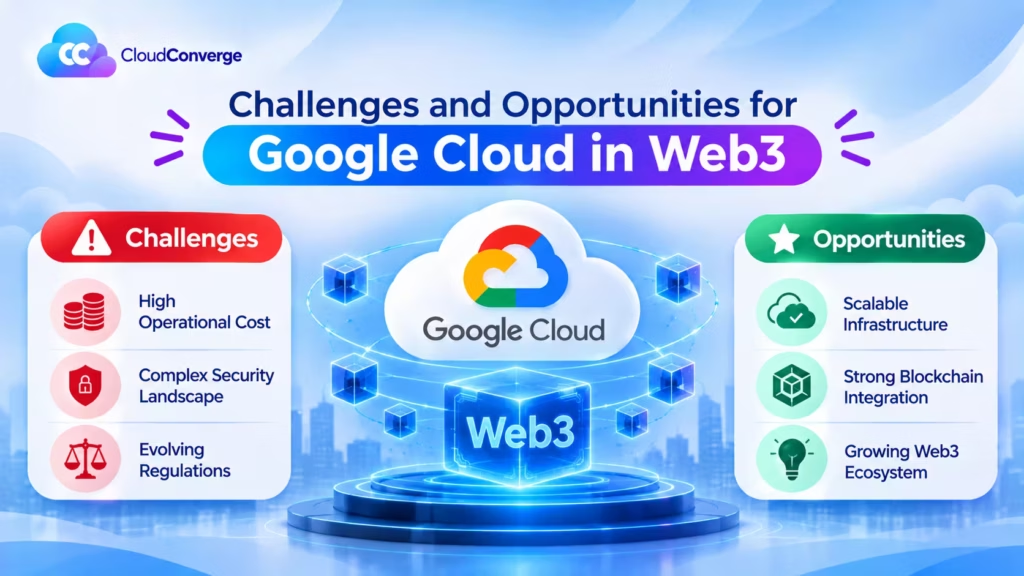
As the adoption of Web3 technologies grows, companies like Google Cloud face challenges and opportunities in harnessing the potential of this decentralized ecosystem. In this article, we will explore the key challenges and opportunities for Google Cloud in the era of Web3.
Interoperability and Standardization
One of the significant challenges for Google Cloud in Web3 is the lack of interoperability and standardization across different blockchain networks and protocols. Web3 consists of multiple blockchain platforms with unique features and functionalities. Google Cloud must address the challenge of providing seamless integration and interoperability between these diverse blockchain networks, allowing developers to build applications that can communicate and interact with multiple blockchains.
- Opportunity: By developing tools, protocols, and APIs that enable interoperability between different blockchain platforms, Google Cloud can position itself as a leader in the Web3 space. Providing a unified interface for developers to interact with various blockchains would simplify the development process and accelerate the adoption of Web3 technologies.
Scalability and Performance
Scalability is a crucial challenge for blockchain networks, as they must handle many transactions while maintaining high performance. Google Cloud faces the task of developing scalable solutions to support the increasing demands of Web3 applications. Improving transaction throughput, reducing latency, and optimizing network performance is essential for delivering a seamless user experience in the decentralized world.
- Opportunity: By leveraging its expertise in cloud infrastructure and distributed systems, Google Cloud can develop innovative solutions that enhance the scalability and performance of blockchain networks. By providing scalable hosting options and optimized infrastructure for Web3 applications, Google Cloud can attract developers and enterprises looking for reliable and high-performance blockchain solutions.
Data Privacy and Security
Web3 introduces new challenges to data privacy and security. As blockchain networks are designed to be transparent and immutable, protecting sensitive data while ensuring privacy becomes a critical concern. Google Cloud must address these privacy and security challenges to build trust among users and enterprises wanting to adopt Web3 technologies.
- Opportunity: Google Cloud can play a significant role in providing secure infrastructure and services for Web3 applications. By integrating privacy-enhancing technologies, such as zero-knowledge proofs and secure multiparty computation, into its cloud offerings, Google Cloud can empower developers to build privacy-preserving decentralized applications. This would attract privacy-conscious users and enterprises, enabling them to leverage the benefits of Web3 without compromising data security.
Developer Adoption and Education
The success of Web3 heavily relies on developer adoption and education. Google Cloud faces the challenge of attracting developers and providing them with the necessary tools, resources, and documentation to build Web3 applications. As Web3 technologies are relatively new and complex, educating developers and making integrating blockchain into their applications easier is crucial for the ecosystem’s growth.
- Opportunity: Google Cloud can create developer-focused initiatives, such as tutorials, workshops, and developer communities, to foster adoption and education around Web3 technologies. By providing comprehensive documentation, sample code, and developer tools specifically tailored for Web3 development, Google Cloud can empower developers to build innovative applications on its platform, strengthening its position in the Web3 ecosystem.
Regulatory and Compliance Challenges
As Web3 evolves, it faces increasing regulatory scrutiny and compliance requirements. Google Cloud must navigate the complex regulatory landscape and ensure its services and solutions comply with relevant regulations, such as data protection laws, anti-money laundering (AML) regulations, and Know Your Customer (KYC) requirements.
- Opportunity:By collaborating with regulatory bodies and industry stakeholders, Google Cloud can help shape the regulatory frameworks surrounding Web3. Building solutions incorporating compliance mechanisms, such as identity verification and transaction monitoring, would enable Google Cloud to cater to the needs of regulated industries and attract enterprises looking to adopt Web3 technologies in a compliant manner.
A seven-step method for marketing Web3 products on cloud infrastructure
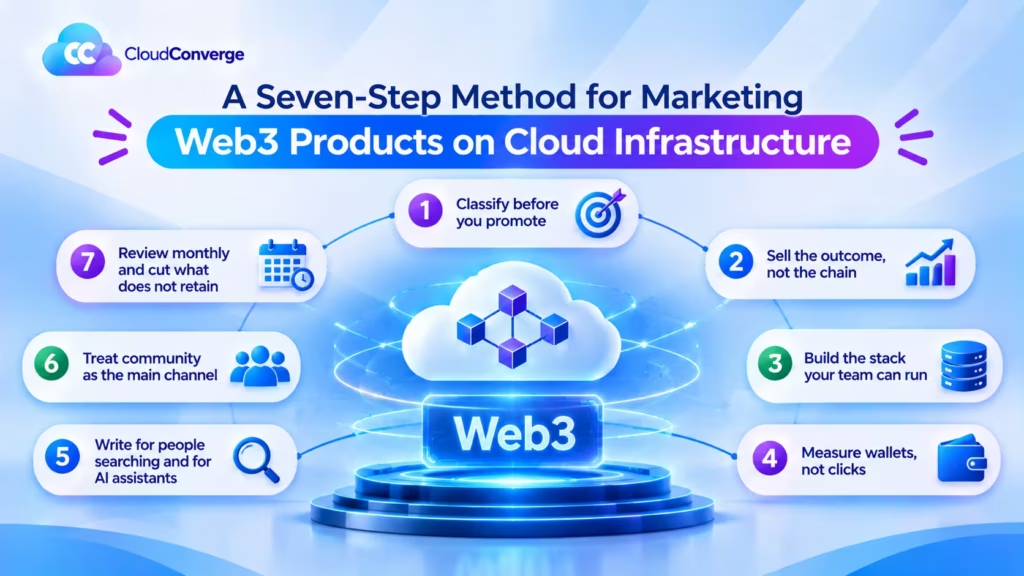
The order matters more than any single tactic. Teams that start with ads and fix compliance later usually pay twice.
1. Classify before you promote
Work out which ad category your product sits in, and which regulator governs each target market, before anyone writes copy. That one decision fixes which channels are open to you. The rules section below sets out the detail by platform and country.
2. Sell the outcome, not the chain
A logistics manager buying a traceability tool cares about fewer disputed shipments, not consensus algorithms. Lead with the business result, then explain the blockchain as the reason it can be trusted. This framing also keeps B2B products clear of financial-promotion territory.
3. Build the stack your team can run
Pick the platform your engineers can patch and monitor without outside help. A familiar setup kept current beats an unfamiliar one chosen for a press release.
4. Measure wallets, not clicks
Connect your web analytics events (visit, sign-up, wallet connect) to onchain events (first transaction, repeat use) in one warehouse. BigQuery public datasets make this possible on Google Cloud without running an indexer; on AWS or Azure, a data provider’s API fills the same role.
5. Write for people searching and for AI assistants
Buyers now ask ChatGPT, Perplexity and Google AI Overviews before they visit a site. Pages with a direct answer near the top, clear definitions, a comparison table and an FAQ are the ones those tools quote. Plain technical explainers also do well with developers, who are often the first evaluators of a Web3 product.
6. Treat community as the main channel
Discord, Telegram, X and developer forums are where Web3 users decide whether to trust a project. Staff them with people who can answer technical questions, publish progress openly, and share bad news before users find it.
7. Review monthly and cut what does not retain
Campaigns that bring wallets which vanish after one transaction cost more than they appear to. Drop them, and move budget to the sources whose users are still active a month later
Managed blockchain on the big three clouds: what launched and what closed
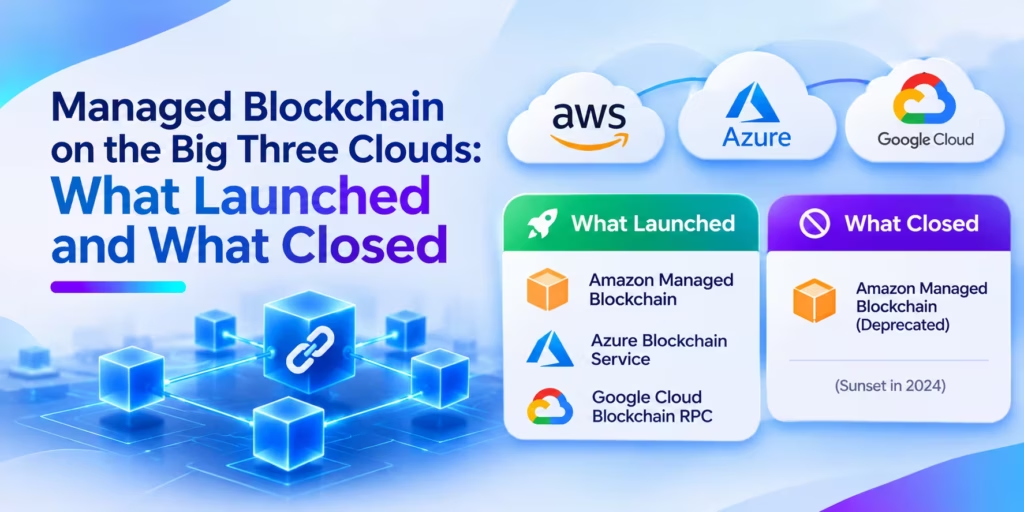
All three hyperscalers tried managed blockchain services, and all three have stepped back. The dates below come from each provider’s own documentation.
| Provider | Service | Status in November 2026 | Key date | Path the provider recommends |
| Microsoft Azure | Azure Blockchain Service | Retired | Closed 10 Sep 2021 | ConsenSys Quorum Blockchain Service, or self-managed VMs |
| Google Cloud | Blockchain Node Engine and Blockchain RPC | Limited support, no new nodes since 15 Jun 2026 | Shutdown 15 Dec 2026 | QuickNode |
| AWS | Amazon Managed Blockchain (Access, Query, Hyperledger Fabric) | Closed to new customers since 29 Oct 2026 | Access ends 29 Sep 2027 | Self-managed nodes with AWS Blockchain Node Runners, or partners such as Alchemy, QuickNode and Kaleido |
Sources: AWS end-of-support notice, Google release notes, InfoQ on the Azure retirement.
The lesson for a small team is practical. If your marketing promises uptime, speed or “powered by” a named service, that promise now depends on a vendor roadmap you do not control. Keep the RPC endpoint in configuration rather than in code, test a second provider before launch, and tell your community early when you migrate. A calm migration post builds more trust than a silent outage during a campaign.
Enhanced Data Security and Privacy
By integrating Web3 technologies into its infrastructure, Google Cloud can enhance data security and privacy for its users. Blockchain technology, the underlying framework of Web3, provides a decentralized and immutable ledger that can safeguard sensitive information. With increased concerns about data breaches and privacy violations, Google Cloud’s adoption of Web3 can help build trust and ensure data integrity.
Improved Transparency and Trust
Web3 platforms enable transparent and auditable transactions, creating higher trust among participants. By incorporating Web3 into its services, Google Cloud can leverage these features to enhance transparency and trust for its users. This can be particularly beneficial for industries such as supply chain management, finance, and healthcare, where trust and transparency are critical.
Decentralized Cloud Infrastructure
Web3 introduces the concept of decentralized cloud infrastructure, where computing resources are distributed across a network of nodes. By leveraging this concept, Google Cloud can create a more resilient and scalable infrastructure. Decentralization reduces the risk of single points of failure and improves system performance, ensuring high availability and better user experiences.
Smart Contract Integration
Smart contracts can automate and streamline various business processes, eliminating the need for intermediaries and reducing costs. Google Cloud’s integration of smart contracts into its services can unlock new possibilities for industries, including supply chain management, finance, and legal sectors. This integration can improve efficiency, reduce friction, and enable new business models.
NFTs and Digital Asset Management
Non-Fungible Tokens (NFTs) have gained significant popularity in recent years, enabling the ownership and trading of unique digital assets. Google Cloud’s Web3 strategy can provide infrastructure support for NFT platforms, facilitating secure storage, distribution, and management of digital assets. This can have profound implications for creators, artists, collectors, and industries like gaming and entertainment.
Blockchain-as-a-Service (BaaS) Offerings
Google Cloud can introduce Blockchain-as-a-Service (BaaS) offerings, allowing businesses to easily adopt blockchain technology without the complexity of building and maintaining their infrastructure. By offering BaaS, Google Cloud can enable businesses to leverage the benefits of blockchain, such as increased security, immutability, and efficiency, while focusing on their core competencies.
Collaboration with Web3 Startups
To strengthen its Web3 strategy, Google Cloud can collaborate with innovative startups. By partnering with emerging companies developing groundbreaking Web3 solutions, Google Cloud can tap into their expertise and accelerate the adoption of these technologies. Collaborations range from joint research and development projects to creating specialized Web3 services.
Which cloud suits a Web3 product in 2026?
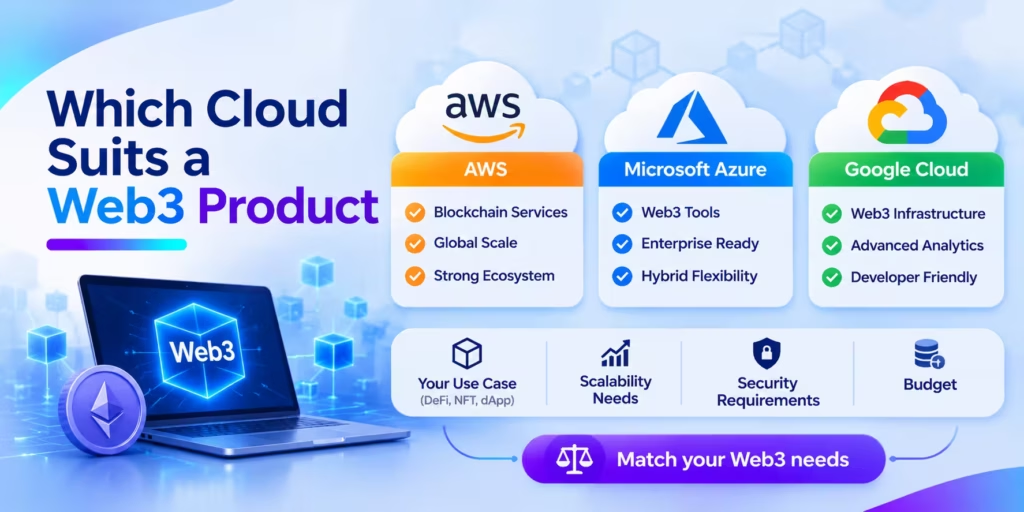
No hyperscaler “wins” Web3 now, because none of them runs public-chain nodes for new customers. The useful question is which one fits the rest of your business. A short rule of thumb:
- AWS suits teams that want the widest service catalogue and the option to buy partner node services through AWS Marketplace. Alchemy, for example, sells through AWS Marketplace, so spend lands on one bill.
- Microsoft Azure suits B2B Web3 products sold to companies already on Microsoft 365 and Entra ID, where single sign-on and procurement through an existing Microsoft agreement shorten the sales cycle.
- Google Cloud suits analytics-led teams that will use BigQuery public blockchain datasets to measure campaigns and user cohorts.
All three handle self-managed nodes on virtual machines or Kubernetes if you need full control, at the cost of running them yourself. For most SMEs, the cheaper route is a managed RPC provider plus the platform your engineers are most fluent in. Switching clouds for Web3 alone rarely pays back.
For a side-by-side view of each platform’s services and costs, see Cloud Converge’s AWS consulting, Microsoft Azure consulting and Google Cloud consulting pages.
Google Cloud’s Technological Prowess
Google Cloud has a strong foundation in cutting-edge technologies, including artificial intelligence (AI), machine learning (ML), and data analytics. These capabilities position Google Cloud favorably for Web3 applications, which heavily rely on these technologies for smart contracts, decentralized applications (dApps), and tokenization. Google’s domain expertise gives it a competitive advantage over its rivals.
Commitment to Open Source
Web3 is built upon the principles of decentralization and open-source collaboration. Google Cloud has demonstrated its commitment to open-source technologies through initiatives like Kubernetes, TensorFlow, and Istio. This commitment resonates with the ethos of the Web3 community. It can help Google Cloud gain traction among developers and blockchain enthusiasts.
Collaboration with Blockchain Projects
Google Cloud has actively pursued partnerships with prominent blockchain projects. It joined forces with Chainlink, a leading decentralized oracle network, to integrate its services with Google Cloud’s BigQuery, enabling developers to access on-chain data more efficiently. Such collaborations showcase Google Cloud’s determination to engage with the Web3 ecosystem and foster innovation.
Enhanced Data Security and Privacy
Security and privacy are critical considerations in the Web3 landscape. Google Cloud has invested heavily in security measures, including advanced encryption, identity and access management, and compliance certifications. Its commitment to providing robust security solutions can instill confidence among enterprises and individuals looking to adopt Web3 technologies.
Network Effects and Developer Ecosystem
AWS and Azure have built substantial developer communities and enjoy strong network effects. However, Google Cloud’s vast existing developer ecosystem, fueled by its popular services like Google Kubernetes Engine and Google Cloud Functions, can provide a competitive edge. By leveraging its extensive network and developer resources, Google Cloud can attract talent and drive innovation in the Web3 space.
Market Reach and Customer Base
AWS and Azure currently dominate the cloud market, with a significant share of enterprise customers. However, Google Cloud has been making steady progress and expanding its customer base. Its ability to cross-leverage its existing customer relationships and expand into the Web3 market can give it a competitive advantage.
Geographic Expansion
The global nature of Web3 requires best cloud service providers to have a wide geographical footprint. AWS and Azure have made substantial investments in data centers across the world. Although not as expansive as its competitors, Google Cloud has been actively expanding its infrastructure. Continued investments in data centers can help Google Cloud compete effectively globally.
Competitive Pricing and Cost Efficiency
Cloud service pricing is a crucial factor for organizations considering Web3 adoption. While AWS and Azure have competitive pricing models, Google Cloud has a reputation for being cost-efficient. It offers discounts and flexible pricing options, making it an attractive choice for cost-conscious businesses. This advantage can give Google Cloud an edge over its competitors in the Web3 market.
Potential Challenges
While Google Cloud has significant strengths, it faces certain challenges in its pursuit of Web3 dominance. AWS and Azure have established a strong foothold in the cloud market with trusted brands and extensive service offerings. Overcoming this entrenched competition will require Google Cloud to differentiate itself further and offer unique value propositions tailored specifically for Web3 use cases.
Traditional SaaS marketing vs Web3 product marketing on the cloud
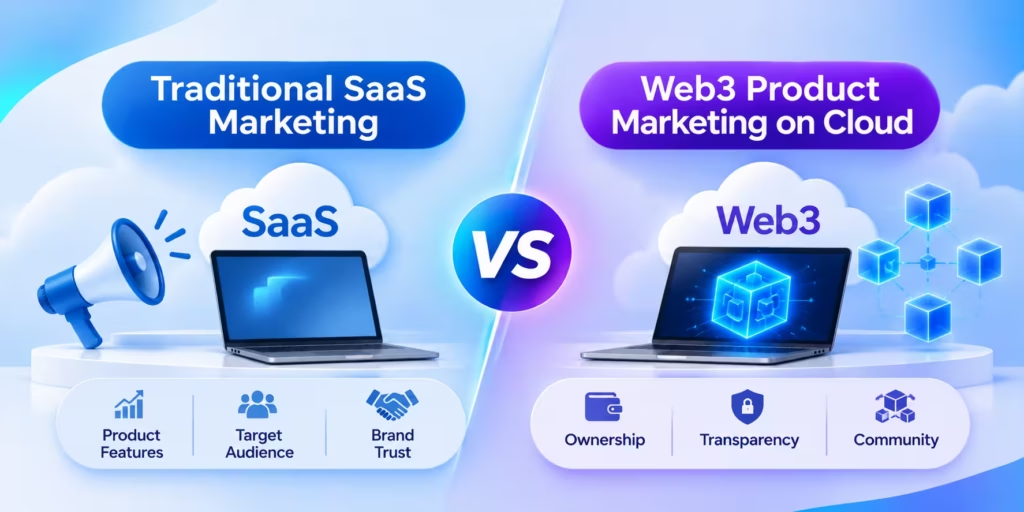
The classic B2B playbook still works for Web3 products that sell software to businesses; it breaks where tokens, wallets and financial-promotion rules enter.
| Criteria | Traditional SaaS marketing on the cloud | Web3 product marketing on the cloud |
| Paid search | Open to most categories under standard ad policies | Allowed without certification only for businesses that do not involve buying, holding or exchanging crypto; exchanges and wallets need Google certification; ICOs and DeFi trading protocols are banned |
| Trust signals | Case studies, reviews, security certifications | Code audits, open-source repositories, published white paper where MiCA requires one, transparent token documentation |
| Main conversion event | Form fill, demo request or trial sign-up | Wallet connection followed by a first onchain action |
| Analytics | Web analytics plus CRM | Web analytics joined to onchain records in a data warehouse |
| Community | Support forum, often optional | Discord, Telegram and X act as the primary distribution channel |
| Regulatory review | General advertising codes (ASA in the UK, ASCI in India) | Financial-promotion rules: FCA regime in the UK, MiCA in the EU, ASCI virtual digital asset guidelines in India |
| Infrastructure risk | Hosting outage | Hosting outage plus RPC rate limits and provider service retirements |
Recommendation: If you sell blockchain-based software to businesses and never ask buyers to purchase tokens, run the traditional playbook almost unchanged, including Google Ads, LinkedIn and SEO. If your product involves tokens, wallets or trading, lead with content, community and owned channels, and treat paid media as a certified, country-by-country exception.
Six questions for any cloud or marketing partner before you sign
- Which of our products fall into Google’s allowed, certified or prohibited crypto categories, and how did you decide?
- Where will our RPC endpoint be configured, and how fast can you switch provider if one closes?
- Have you load-tested a landing page and wallet flow at launch traffic, and can we see the method?
- Which data regions will hold our users’ personal data, and why?
- How will you connect campaign data to onchain activity, and who owns that data afterwards?
- Who supports the stack after launch, under what engagement model, and what does a handover include?
A partner who answers the first two questions with specifics usually handles the rest well. Vague answers there are the clearest warning sign.
Metrics that prove the marketing is working
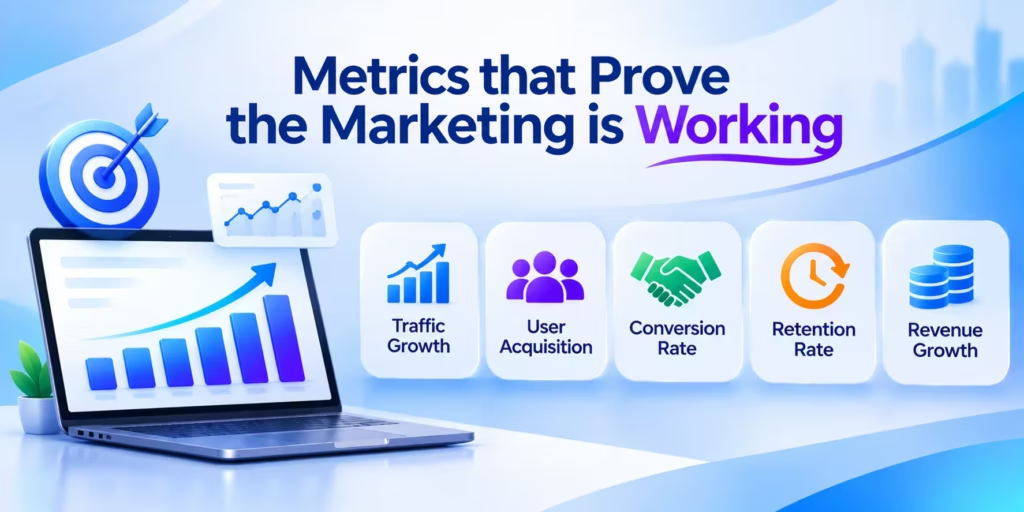
Record a baseline for each metric before launch, then compare at 30 and 90 days.
- Cost per retained wallet: spend divided by wallets still active after 30 days. This replaces cost per click as the headline number.
- Funnel conversion: visits to wallet connections to first onchain action. A sharp drop at wallet connection usually points to a UX or RPC problem, not weak messaging.
- RPC error rate during campaigns: failed calls as a share of total while ads run. Spikes here waste paid traffic.
- Landing page speed: Largest Contentful Paint under 2.5 seconds on mobile, Google’s “good” threshold.
- AI-assistant referrals: sessions arriving from chatgpt.com, perplexity.ai and similar sources, tracked as a separate channel in your analytics.
- Organic visibility: impressions and clicks in Google Search Console for your primary question, including this one.
What to do this month, depending on where you stand
- Running on Google Blockchain Node Engine: migrate now. The 15 December 2026 shutdown leaves only weeks, and a failed endpoint during a campaign cost more than the move.
- Running on Amazon Managed Blockchain: you have until 29 September 2027, so schedule the switch for a quiet period rather than next to a launch.
- Not tied to either: your biggest gain is measurement. Joining campaign data to onchain activity shows which channels bring users who stay, and which only bring clicks.
Whichever applies, settle the ad category question before you increase spend. It is the cheapest decision to get right and the most expensive to get wrong.
Frequently asked questions
Can I run Google Ads for my Web3 product?
Yes, if your business does not involve buying, holding or exchanging crypto, for example a blockchain-based supply-chain tool. Exchanges and wallets need Google certification and can only target approved countries. Ads for ICOs, DeFi trading protocols and token trading are not allowed anywhere.
Which cloud is best for hosting a Web3 app in 2026?
The one your team already runs well, because none of AWS, Azure or Google Cloud now offers managed public-chain nodes to new customers. Choose Google Cloud if BigQuery analytics drives your marketing, Azure if your buyers live in Microsoft 365, and AWS for the widest service range and Marketplace billing.
What happens to my app when Google Blockchain Node Engine shuts down?
On 15 December 2026 Google deletes all remaining nodes and Blockchain RPC endpoints, and anything still calling them stops working. Move to another RPC provider before then; Google’s migration guide names QuickNode, and the switch is mainly an endpoint and authentication change.
Do I need a white paper before marketing a token in the EU?
If MiCA requires a white paper for your offer, you cannot publish any marketing until the white paper is out. Every ad, post and landing page must then match it and carry the mandatory statement that no EU authority has approved it.
Do UK crypto marketing rules apply if my company is based in India?
Yes. The FCA regime covers anyone promoting qualifying cryptoassets to UK consumers, wherever the firm is based. You need one of the four lawful routes in place before targeting UK audiences with token promotions.
How much does it cost to set up the cloud and marketing for a Web3 launch?
It depends on scope: whether you need hosting only, analytics, content and SEO, or paid campaigns too, and which engagement model suits you. Cloud Converge offers fixed price, dedicated team, agile and hourly models, and a free consultation leads to a written quote.