


Most support teams at growing companies hit the same wall. Ticket volume climbs faster than headcount, the same twenty questions fill half the day, and customers in other time zones wait until morning for a reply. Hiring more agents clears the queue for a quarter then the pattern returns.
An AI chatbot, built well, takes the repeatable questions off that queue. The hard part is the building: grounding answers in your own policies, connecting to order or CRM data and passing a conversation to a person without losing the thread. That is the work AI chatbot developers for hire are brought in to do, and it is where most of the cost and risk of a support bot sits.
This guide covers what such a team builds, what the bot costs to run afterwards, which hiring model suits a small or mid-sized company, and what to check before you sign.
When Should You Hire AI Chatbot Developers for Customer Support?
Hire AI chatbot developers when a support bot must answer from your own policies and systems, not just a generic FAQ. They build the knowledge retrieval, integrations, handoff rules and testing that off-the-shelf tools leave to you. Cloud Converge provides dedicated chatbot developers for SMEs in Europe and Asia.
- What it is: AI chatbot development for support means designing, building and maintaining a conversational assistant that uses a large language model, retrieval-augmented generation (RAG) and connections to your business systems.
- Who it suits: companies of roughly 10 to 250 staff whose support queue grows faster than the team, especially those serving customers across time zones or languages.
- What is included: ticket analysis and scoping, knowledge base and retrieval setup, CRM and helpdesk integration, handoff design, testing, launch and monitoring.
- How we work: fixed price, dedicated team, agile or hourly engagement.
- Proof: ISO 27001 and ISO 9001:2015 certification, AWS and Microsoft Solutions Partner status, and a published multilingual chatbot case study.
- Region note: from 2 August 2026, the EU AI Act obliges chatbots serving EU users to disclose that they are AI (Regulation (EU) 2024/1689, Article 50).
How it works
- Tag a recent quarter’s tickets by reason to find what is worth automating.
- Gather and clean the policies, product data and past replies the bot will draw on.
- Connect the bot to the systems that hold live answers, such as orders or bookings.
- Define when a conversation moves to a person, and what context travels with it.
- Test against real past questions, including ones the bot should decline.
- Launch on one channel, measure for a month, then add channels and languages.
Round-the-Clock Answers Without Night Shifts
A well-built bot answers at 3 a.m. the same way it answers at noon. That matters most for companies selling into several time zones from one office: a UK retailer with customers in the Gulf, or an Indian SaaS firm serving Europe, can cover overnight hours without a second shift.
Two limits are worth stating plainly. The bot can only answer what its knowledge base and connected systems hold, so out-of-hours coverage is only as good as the content behind it. And some requests, such as refunds above a set value or changes to account ownership, should wait for a person whatever the hour. A good build tells the customer so, logs the request and gives a reply time instead of inventing an answer.
Waiting time for customers gets reduced
Speed is everything when it comes to customer service. It is only then that the experience of customers improves and builds trust in your brand. An AI chatbot, while being able to manage thousands of conversations at one time, saves customers from the headache of standing in a queue, listening to messages like “please hold,” or getting frustrated. Outsourcing work to a company specializing in AI-powered customer support chatbot development lets you build bots that understand customer intent, pick up the relevant information, and respond within seconds. That means support scaling will be effective without adding agents.
Taking Repetitive Requests Off the Queue
Password resets, order tracking, delivery windows, appointment changes and returns-policy questions make up a large share of most support inboxes. Each needs little judgement but arrives in volume, which makes this group the first candidate for automation.
How much a bot can resolve depends on your own tickets, not an industry average. Before any build, pull three months of tickets, tag them by reason, and mark the ones that need only a lookup plus a policy answer. That share is your realistic ceiling. Developers who skip this step and promise a fixed percentage are guessing.
The bot then needs read access to the systems holding the answer, such as the order platform, booking calendar or helpdesk, and write access only where an action is easy to reverse.
Personalized Support Experiences
The modern chatbots powered by AI have moved one step ahead from pure rule-based bots by deploying the power of machine learning and NLP to really understand the customers’ emotions, preferences, and history.The bots designed by an experienced AI chatbot development company integrate with your CRM or customer database and, therefore, can make personalized recommendations and responses.
What Personalisation Depends On
Personalised replies come from data the bot is allowed to see, not from reading a customer’s mood. In practice that means confirming who is asking, then looking up their order history, plan or open tickets through the CRM or helpdesk API.
Three decisions shape this work: which fields the bot may read, how a customer proves identity before account details appear, and how long transcripts are kept. Settle them with whoever handles data protection before development starts, because changing them after launch usually means reworking the integration layer
Cost-Effective Scaling
Hiring and training new customer service agents every time your business grows is expensive and slow. Chatbots help you scale without the heavy cost. Once set up, a chatbot can handle any number of conversations at a fraction of the cost compared to human support. Scaling your business? Update the bot to include new queries or integrate it into yet another system. When you outsource customer support with the help of an AI Chatbot Development Company, you are ensuring your chatbot is scalable, secure, and optimized for your business objectives.
The Running Costs Nobody Puts in the Quote
A support bot has a build cost and a monthly cost, and SME budgets often plan only for the first. The second has four parts.
- Model usage. LLM providers bill per token, with separate rates for input and output (OpenAI API pricing). Long system prompts and large retrieved passages are paid for on every message, so prompt and retrieval design shape the monthly bill.
- Channel fees. Since 1 July 2025, Meta has charged per delivered template message on the WhatsApp Business Platform (Meta pricing documentation). Free-form replies inside the 24-hour customer service window carry no such charge, but order updates and reminders sent outside it do.
- Content upkeep. Every price change, new product or revised policy has to reach the knowledge base, or the bot starts giving stale answers.
- Review time. Someone must read a sample of conversations each week, check flagged answers and adjust prompts or content.
Ask any developer you are considering for a monthly running-cost estimate at your expected conversation volume, not only a build price.
Seamless Handoff to Human Agents
Though AI chatbots can address most of the basic queries, there is always scope that requires a human touch, which can include billing disputes and some technical issues.
While developing the bot for you, the professional development company makes sure it knows exactly when it needs to transfer the conversation to a live agent. It does so seamlessly and transfers all the previous details of the chat onto the agent.
This would make the customer feel heard and save the agents from asking repetitive questions. It is a perfect balance between automation and human empathy.
Deciding When the Bot Should Step Aside
Handoff rules belong in the design, not in a patch after complaints arrive. Common triggers:
- The customer asks for a person, in any wording.
- The same question goes unresolved twice in a row.
- The request involves money above a set limit, a complaint, or a legal or safety matter.
- Retrieval finds no matching source, so any reply would be a guess.
That last trigger matters more than it looks. In Moffatt v. Air Canada (2024 BCCRT 149), a Canadian tribunal held the airline responsible for a bereavement-fare policy its website chatbot described wrongly, and dismissed the idea that the chatbot was answerable for itself. A bot that hands over when it lacks a source is cheaper than one that improvises.
At handoff, the agent should receive the transcript, the result of the identity check and the records already looked up. The customer should be told roughly how long the wait will be.
Actionable Insights from Customer Conversations
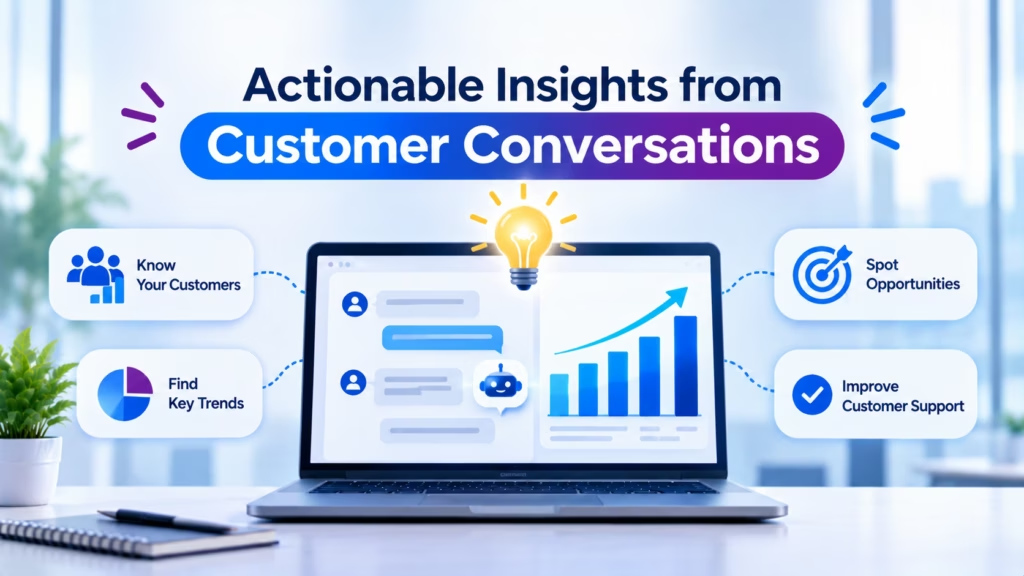
Every customer’s chat is a source of extremely valuable data. Because of that, AI chatbots are in a position to track patterns and common issues while measuring satisfaction based on user feedback.While AI chatbot development companies provide analytics setup to businesses for customer support, it also helps in gaining clear insights into the behavior of customers. For example:
- What are the most frequently asked questions?
- What time of day do most of your customers contact you?
- Which products or services receive the highest volume of support requests?
This information informs decisions for the business, enriches products, and can help you fine-tune your overall support process.
Multi-channel integration
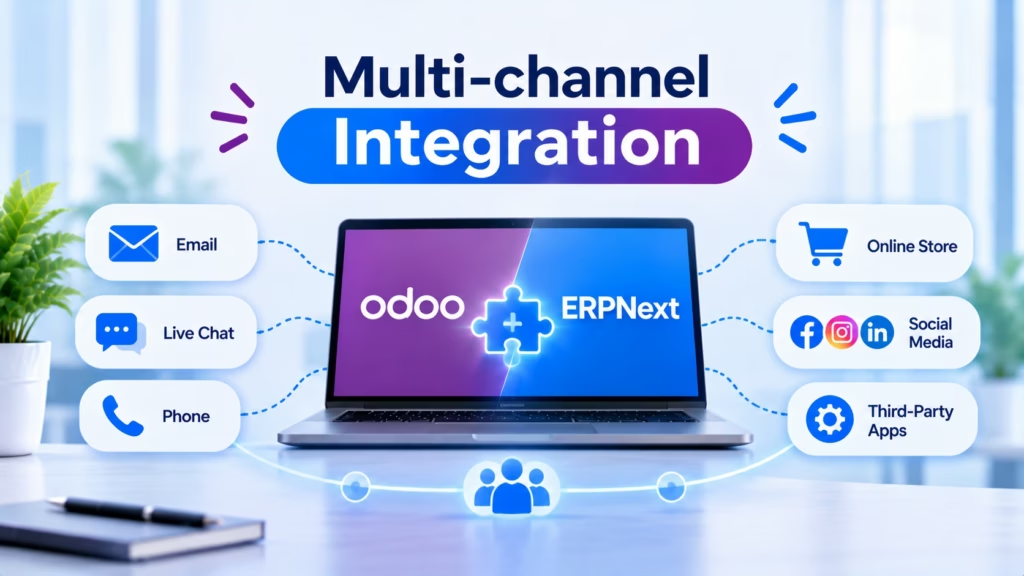
Today’s customers reach out through various channels: the website, mobile apps, WhatsApp, Facebook Messenger, to name just a few. Keeping track of all these manually is a very challenging job.AI chatbot development companies build bots that integrate with all your means of communication. This means that your customers will have similar experiences with you, whichever channel they may contact you through.Be it website chat, an email, or a message from social, the chatbot extends help in an instant and keeps the voice of your brand constant across platforms.
What Each Channel Needs Before Go-Live
Every channel adds its own setup work, which is why launching on one first is usually wiser.
- Website chat: a widget on your site, the AI notice shown at the start of each chat, and a fallback contact route for when agents are offline.
- WhatsApp: a WhatsApp Business Platform account, a registered business phone number, and approved message templates for anything sent outside the 24-hour service window.
- Messenger and Instagram: a connected Meta business page and the app permissions needed for messaging.
- Email: rules for which inbound messages the bot drafts replies to, and whether a person approves each draft before it is sent.
Shared history across channels needs a single customer record, usually in the CRM, so someone who starts on WhatsApp and follows up by email is recognised as one person. See how this is set up on our ChatBot Integration page.
A Shared Answer Base for New Agents
The knowledge base behind a support bot doubles as training material. When policies, product details and approved replies sit in one maintained source, a new hire searches the same content the bot uses instead of interrupting colleagues.
Some teams add an internal assistant beside the customer-facing bot, so agents can ask questions in plain language during live chats. What keeps both useful is ownership: one named person updates the source when a policy changes, and bot and agents pick up the change at the same moment
Building Long-Term Customer Relationships
Customer service isn’t solely to solve problems but to build trust. AI-powered chatbots can definitely follow up on an interaction that involves any service, gather feedback, and even offer something personalized in the form of offers or updates. This kind of follow-up helps the business stay connected with its customers in a meaningful manner. Having the right AI Chatbot Development Company for customer support lets your business have long-term relationships through presence, usefulness, and consistency.
Scripted Bots, SaaS Add-ons and Custom Builds Compared
Older scripted bots still suit narrow, stable tasks, while custom builds earn their cost when answers depend on your own data and systems.
| Criteria | Scripted decision-tree bot | AI add-on inside a helpdesk platform | Custom LLM bot from hired developers |
| How replies are produced | Fixed menus and keyword rules written in advance | The vendor’s model answers from your help-centre articles | A model you choose answers from your documents and live system data |
| Setup effort | Low; flows built in a visual editor | Low to moderate; mostly configuration | Higher; needs scoping, integration and testing |
| Reach into your systems | Limited to what the builder supports | Limited to the vendor’s connectors | Built for your CRM, ERP, order or booking systems |
| Control over data and behaviour | High, since every reply is pre-written | Set by the vendor’s terms and settings | High; you decide hosting, retention and model |
| Risk of a wrong reply | Low, though it often misreads the question | Moderate; tied to article quality | Moderate; managed through retrieval limits, testing and handoff rules |
| Cost pattern | Low subscription | Per seat, conversation or resolution, set by the vendor | Build fee plus model usage and upkeep |
| Best fit | A few predictable flows, such as opening hours or order status | Teams already on that helpdesk with a current help centre | Questions that depend on account data, several systems or several languages |
If your support questions fit a dozen predictable flows, a scripted bot remains a sound, cheap choice and many teams run one for years. If you already use a helpdesk with an AI add-on and keep its help centre current, try that first. Bring in developers for a custom build when the bot must read live account data, work across systems the add-on cannot reach, or meet data-handling terms a vendor will not offer.
Freelancer, In-House Engineer or Dedicated Team
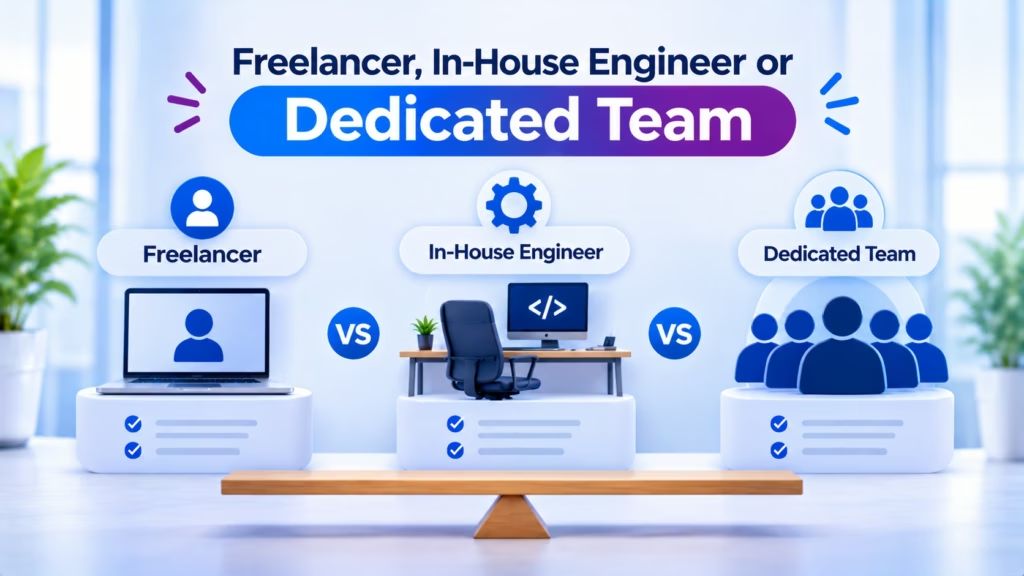
Who you hire shapes the project as much as what you build. For a company without an AI engineer on staff, the choice usually comes down to three routes.
- Lower hourly cost and quick to start, which suits a prototype or a narrow bot. The risk is continuity: one person holds the knowledge, and holidays, illness or a better-paid contract can stall the work.
- In-house hire. Full control, and the knowledge stays in the business. Hard to justify for a single bot, and one engineer still lacks a tester, a conversation designer and cover for leave.
- Dedicated team from a development partner. Engineers, QA and a project lead assigned to your account, with continuity written into the contract. It costs more per month than a freelancer, but the team is already formed and can scale down after launch.
At Cloud Converge, chatbot work runs on one of four engagement models: fixed price when scope is clear, a dedicated team for an ongoing roadmap, agile sprints when requirements will shift, or hourly for small enhancements. A pattern that suits many SMEs is a fixed-price first release followed by hourly support
Questions to Put to Any Chatbot Development Team
A short call built around these questions separates teams that have shipped support bots from those that have built demos.
- How will the bot avoid answering when it has no source, and can you show that working on our content?
- Which model will you use, where is it hosted, and is our data used for training?
- Who owns the code, prompts, knowledge base and conversation logs when the contract ends?
- How will you test accuracy before launch, and what test set will you leave behind for future changes?
- Where and how will the AI disclosure appear in the chat?
- What does support cost after launch, and who updates content when our policies change?
Answers should be specific to your use case. A team that cannot describe its testing method in two sentences has probably not needed one yet. For a longer checklist, see Questions to Ask Before Hiring an AI Chatbot Development Company.
Data Protection and AI Rules for UK, EU and Indian Deployments
Three sets of rules come up most often for SMEs selling in Europe and India.
- EU AI Act. Article 50 has applied since 2 August 2026. Chatbots must be designed so people in the EU learn they are interacting with an AI system, at the latest at the first interaction, unless that is obvious from context. The duty sits with the provider, so a custom build’s contract should state who carries it.
- UK GDPR. The ICO’s guidance on AI and data protection says most AI uses involving personal data will need a data protection impact assessment, along with clear information on how chat data is used.
- India’s DPDP framework. The Digital Personal Data Protection Rules, 2025 were notified on 13 November 2025 and are being phased in, bringing notice, consent and breach-reporting duties that cover chat transcripts containing personal data.
None of this blocks a support bot. It does mean disclosure wording, retention periods and data-processing terms belong in the project plan from week one.
Measuring Whether the Bot Pays Its Way
Record a baseline for four weeks before launch, or there is nothing to compare against. Then track:
- Resolution without handoff: the share of conversations the bot closes with no agent involved.
- Repeat contact: whether those customers came back about the same issue within seven days.
- Handoff quality: how often agents had to ask for details the bot had already collected.
- Satisfaction: ratings after bot-only chats, set against ratings for agent chats.
- Cost per resolved conversation: model, channel and upkeep spend divided by bot-resolved conversations.
- Response and resolution times: movement against the pre-launch baseline.
Read repeat contact alongside resolution. A bot can look efficient by ending conversations that were never solved.
Next Steps for Your Support Team
Scaling support does not have to mean scaling headcount at the same rate. A chatbot that answers routine questions from your own data, passes harder cases to a person with full context, and is measured against a clear baseline can absorb growth that would otherwise need new hires.
How well that works rests on who builds the bot and how it is maintained. Cloud Converge designs, builds and supports AI chatbots for small and mid-sized businesses, holds ISO 27001 and ISO 9001:2015 certification, and typically delivers chatbot projects in six to ten weeks depending on integrations. If you are weighing a build, book a free consultation and bring three months of ticket data; it makes the first conversation far more productive.
Frequently Asked Questions
Where can I find AI chatbot developers for hire who understand customer support?
Look for developers with a support bot in production that connects to a helpdesk or CRM, rather than demo assistants. Freelance marketplaces, specialist agencies and development partners such as CloudConverge all offer this skill. Ask each one for a working example and how it handles questions it cannot answer.
How much does it cost to hire chatbot developers?
Price depends on scope, the number of integrations, languages and the engagement model, so a figure quoted before anyone has seen your tickets is a guess. Budget separately for monthly running costs: model usage, channel fees and content upkeep. CloudConverge provides a quote after a free consultation.
How long does a customer support chatbot take to build?
CloudConverge’s AI chatbot projects typically take 6 to 10 weeks, depending on complexity and integrations. A single-channel bot drawing on a clean knowledge base sits at the shorter end, while several systems or languages push it longer.
Will a chatbot replace my support agents?
For most SMEs, no. It absorbs routine, repeatable questions so agents can concentrate on complaints, exceptions and sales conversations. Expect the team’s work to change rather than the team to shrink overnight.
Do I need to tell customers they are talking to a bot?
For customers in the EU, yes, because the AI Act’s transparency rules took effect on 2 August 2026. Elsewhere it is still sensible practice, since it sets fair expectations about when a person will step in. A one-line notice when the chat opens is enough.
What happens after the chatbot goes live?
The bot needs content updates whenever policies or products change, a weekly review of sample conversations, and monitoring of model and channel spend. Agree in the contract who handles each task and how quickly fixes are made.