


In today’s fast-evolving digital landscape, businesses need fast, scalable and dynamic web applications to stay competitive. Traditional web development methods, while effective in the past, often struggle to keep up with modern demands for performance, interactivity and user experience. React, a powerful JavaScript library developed by Facebook, has emerged as a game-changer in web development, offering businesses an efficient and future-proof alternative.
Why This Matters Beyond the Code
Most people don’t care what framework their website runs on. They care that it loads fast that the checkout works and that new features don’t take three months to ship. That’s where the technology choice shows up in your numbers: slow pages lose visitors and a tangled codebase turns every small change into a big project. React helps with both and here’s how it compares with the traditional approach.
Performance Optimization: Virtual DOM vs. Traditional Rendering
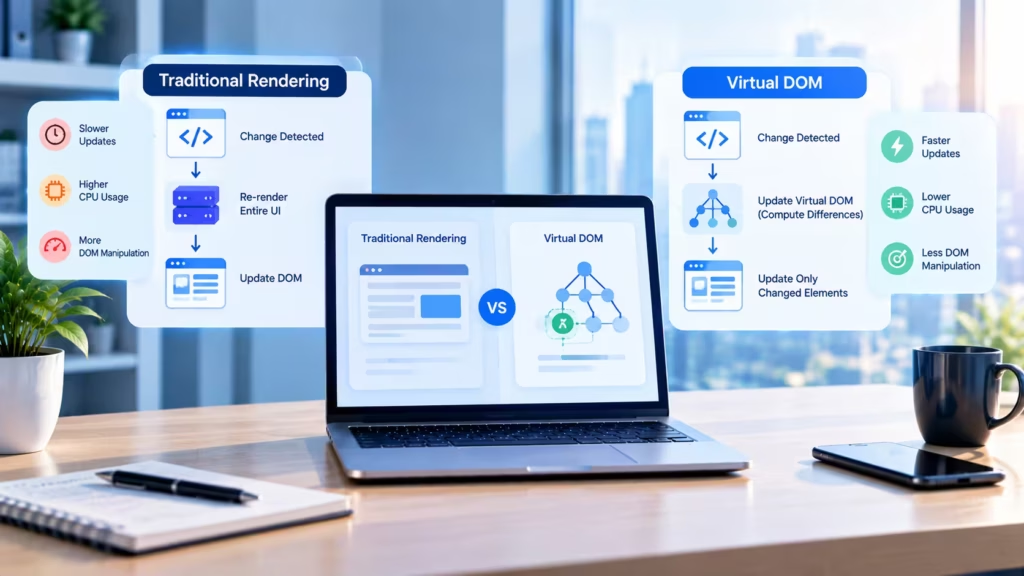
One of the biggest drawbacks of traditional web development is inefficient page rendering. When a user interacts with a website built using traditional methods, the browser reloads the entire page, leading to slow load times and poor performance. React solves this issue with its Virtual DOM (Document Object Model). Instead of reloading the entire page, React updates only the components that have changed, resulting in significantly improved performance and a seamless user experience. This optimization is crucial for businesses that require fast-loading, interactive web applications.
Component-Based Architecture for Scalability
Traditional web development relies on monolithic structures, making it challenging to manage and scale applications as business needs evolve. Any changes require updating multiple parts of the codebase, increasing development time and complexity. React follows a component-based architecture, allowing developers to create reusable, independent components. This modularity makes it easier to maintain, update and scale applications. Businesses can rapidly expand their digital platforms without overhauling the entire codebase.
SEO Optimization and Server-Side Rendering (SSR)
SEO is a major concern for businesses relying on online visibility. Traditional JavaScript-based web applications often face challenges with search engine crawling, which can negatively impact rankings. React, especially when used with frameworks like Next.js, supports server-side rendering (SSR). This ensures that web pages load faster and are easily indexed by search engines, improving organic search performance. Businesses leveraging React benefit from enhanced online visibility and increased web traffic.
Enhanced User Experience with Interactive UI
Modern users expect dynamic and interactive interfaces. Traditional web development methods often require additional libraries or complex coding to achieve interactive features, making development time-consuming. React simplifies the creation of highly interactive user interfaces with features like real-time updates, dynamic content rendering and smooth transitions. Businesses can build engaging digital experiences that drive customer satisfaction and retention.
Cross-Platform Compatibility with React Native
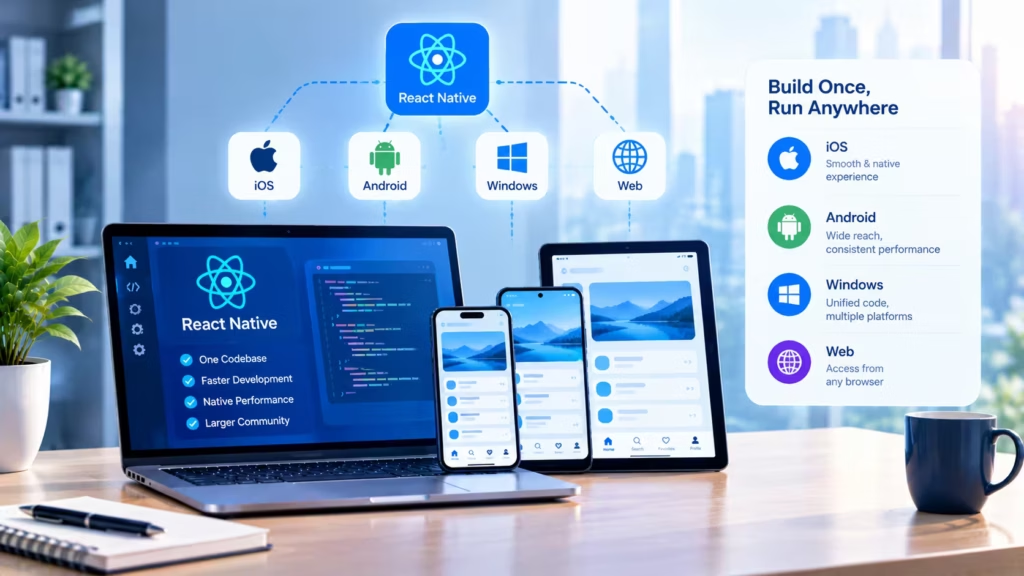
Businesses often need both web and mobile applications to reach a wider audience. Traditional web development requires separate codebases for web and mobile apps, increasing development costs and time. React Native, an extension of React, allows businesses to develop cross-platform applications using a single codebase. This streamlines development efforts, reduces costs and ensures a consistent user experience across web and mobile platforms.
Strong Ecosystem and Community Support
Traditional web development technologies can become outdated, leading to long-term maintenance challenges. Additionally, businesses relying on niche technologies may struggle to find skilled developers. React boasts a vast ecosystem with an active developer community, extensive third-party libraries and continuous improvements. This ensures businesses have access to the latest advancements, best practices and a strong talent pool for ongoing development and support.
Cost-Effective Development and Maintenance
Traditional web development often requires repetitive coding, higher development time and complex maintenance efforts. Businesses end up spending more on long-term updates and scaling challenges. React’s modularity, reusable components and efficient development approach reduce time and costs. Updates and enhancements can be implemented without disrupting the entire system, making it a cost-effective choice for businesses looking for scalable solutions.
Conclusion
AThe shift from traditional web development to React is driven by the need for high performance, scalability and seamless user experiences. Businesses adopting React gain a competitive edge through faster load times, interactive interfaces, better SEO performance and cost-effective development.
At Cloud Converge Technologies, we specialize in building high-performance React applications tailored to business needs. Whether you’re looking to enhance your digital presence, develop a scalable web application, or transition from traditional development methods, our expert team is here to provide web development Services.
React vs. Traditional Development at a Glance
| Factor | Traditional | React |
| Page updates | Often a full page reload | Only the changed component updates |
| Code structure | Tightly coupled, hard to untangle | Reusable, independent components |
| Growing the product | Changes ripple through the codebase | New features slot in as new components |
| SEO | Can be tricky for JS-heavy pages | Solid with server-side rendering (Next.js) |
| Mobile | Separate codebase | React Native can share much of the logic |
When Traditional Development Is Still the Right Call

Let’s be fair: React isn’t always the answer. If you’re building a five-page brochure site that changes twice a year, a JavaScript framework is more than you need and a simpler build will be faster and cheaper. React starts paying off when the product is interactive, changes often, or needs to grow. If you are not sure which side you are on, that’s worth figuring out before any code is written.
How to Move to React Without Rebuilding Everything

You do not have to rewrite the whole platform in one go. Most teams do better by migrating in stages:
- Audit what you have. Find the slow pages and the parts of the code your developers dread touching.
- Decide what you actually want out of it: speed, SEO, a better interface, a mobile app or all of these.
- Start with one high-impact area, like a customer dashboard or the checkout flow, instead of the whole site.
- Pick the stack to match the goal. React with Next.js if search visibility matters, React Native if mobile is on the list.
- Build a shared component library early. It saves a lot of time on every screen after that.
- Release in small pieces and test as you go so problems show up early.
- Keep monitoring after launch. Performance and security need ongoing attention.
Who You’d Be Working With
At Cloud Converge, every project gets UI/UX designers from the start and our programmers go through third-party testing and scoring before they work on your product. We are ISO 27001 and ISO 9001:2015 certified and have delivered 100+ projects for clients in 12+ countries. You can engage us as a fixed-price project, a dedicated team, an agile engagement, or hourly, depending on what fits your scope.
For more on this topic, see How React Transforms Business Websites into High-Performing Digital Platforms and Powering Modern Web Applications with React and Next.js.
Thinking About Moving to React? Let’s Talk First.
Tell us what you are running today and what’s not working. We will give you a straight answer on whether React makes sense for you and what a sensible first step looks like. Your first consultation is free.
FAQs: React vs. Traditional Web Development
Is React better for every project?
No. It suits interactive, frequently updated products. Simple static sites usually don’t need it.
Will React hurt my SEO?
Not if it’s set up properly. Pairing it with Next.js gives you server-side rendering, so search engines can crawl your pages normally.
Can we migrate gradually?
Yes, and that’s usually the safer route. You move one part at a time while the rest keeps running.
How long will a migration take?
It depends on your app’s size, integrations and how much you want to change. We’d rather look at your project than guess, so book a free consultation and we’ll give you a realistic estimate.
Can we use React for a mobile app too?
Yes. React Native lets you build for iOS and Android with a shared codebase, which usually cuts time and cost.